A stronger dollar is a weaker threat to bitcoin than traders think
Your day-ahead look for Sept. 30, 2026
This is an excerpt from CoinDesk newsletter 'Daybook.' Sign up here, if you haven't already.
The U.S. Dollar Index (DXY) is rallying, which is usually seen as bad news for bitcoin BTC$83,797.13 and other dollar-denominated assets such as gold. The data suggest the link is weaker than that view implies.
DXY, which tracks the dollar against a basket of major currencies, including the euro and the yen, has gained about 2.6% since Sept. 9 and hit a two-month high of 101.69 on Tuesday.
The dollar is the world's reserve currency and sits at the center of global finance and debt. When it rallies, borrowers with dollar debt face higher repayment costs and tend to cut exposure to risky assets. A weaker dollar has the opposite effect.
So in theory, a stronger dollar should weigh on bitcoin. BTC's rally has indeed stalled since Sept. 21, with prices pulling back to $83,000-$84,000 from nearly $87,500. A firmer dollar may be capping the upside, but the damage so far is small.
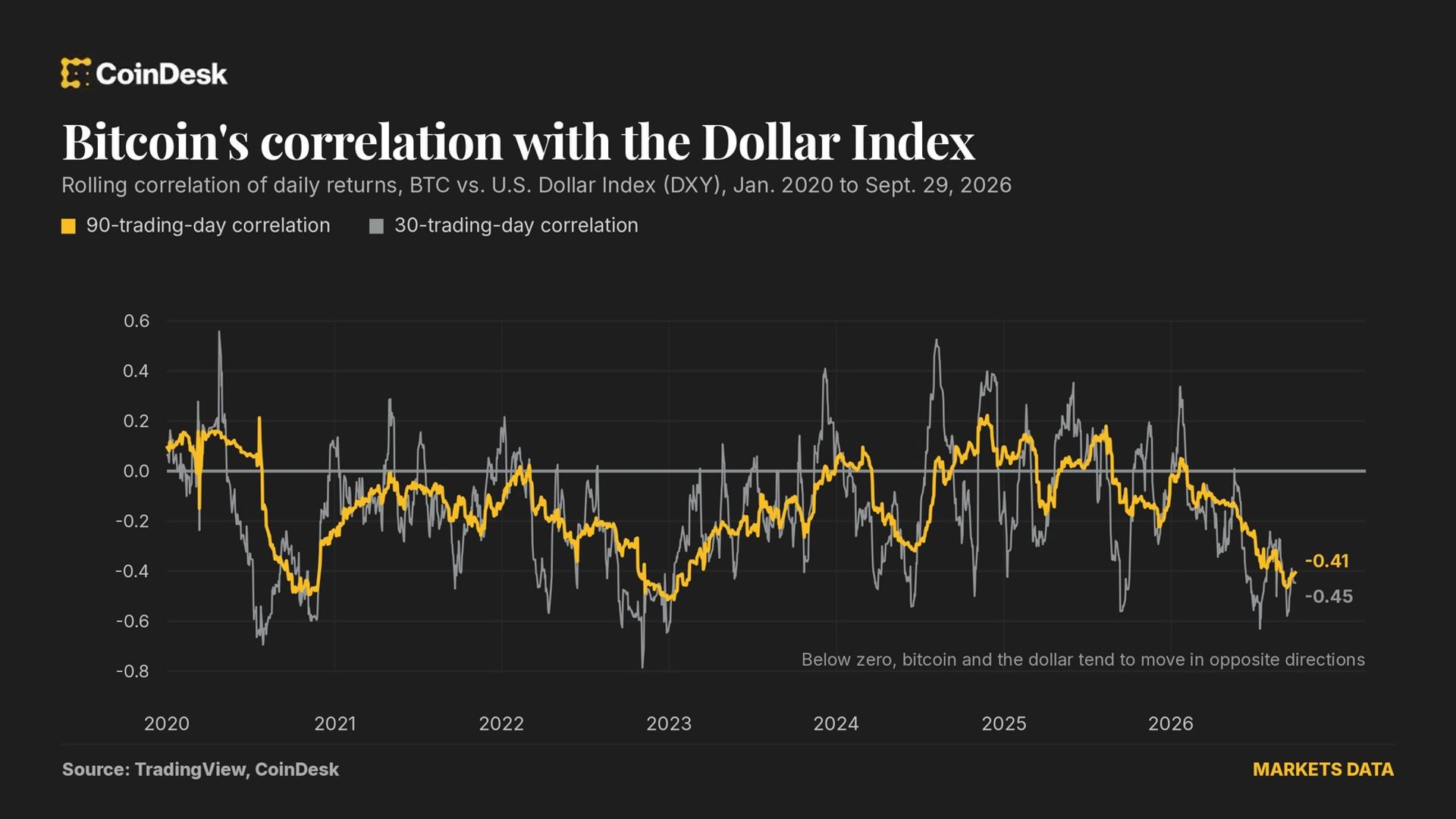
Besides, correlation data backs up that resilience. Over the past 90 trading days, daily moves in BTC and DXY show a correlation of -0.41, according to TradingView data analyzed by CoinDesk. A negative reading means the two tend to move in opposite directions. That is the most negative since February 2023.
However, while the link is real, it is also modest, as the feature image shows. The correlation implies an R-squared of 0.17, meaning DXY accounts for only about 17% of the variation in BTC's daily returns.
The shorter-term reading is noisier. The 30-day correlation is -0.45, but it leans on two days, Aug. 19 and Sept. 3, when BTC jumped more than 5% as DXY fell. Without them, it drops to -0.19.
Zoom out further and the link looks looser still. Since January 2020, the 90-day correlation has averaged -0.14, and it has turned positive at times, peaking at +0.22 in November 2024.
Bitcoin also shows little notable correlation with U.S. Treasury yields, as CoinDesk discussed recently.
Together with its loose link to the dollar, that supports the case for bitcoin as a portfolio diversifier, an asset that moves largely on its own drivers. Whether that independence lasts is worth watching. Stay alert!
Read more: For analysis of today's activity in altcoins and derivatives, see Crypto Markets Today . For a comprehensive list of events this week, see CoinDesk's Crypto Week Ahead.
OpenAI, Google and Meta pledge outside AI audits under voluntary White House deal (CoinDesk): OpenAI, Google, Meta and three other technology companies agreed Tuesday to bring in outside auditors to check their AI safety controls, signing a voluntary White House pact that carries no penalties if they fall short.
Bitcoin bulls have one price level to defend (CoinDesk): The world's largest cryptocurrency hit a high above $87,400 on Sept. 21. It has pulled back since, testing the $82,000 to $83,000 zone. That area matters. It's where bitcoin topped out in May before tumbling to about $57,000 in June.
Pressure on U.S. Treasurys eases after 30-year yield hits highest level since 2002 (CNBC): U.S. Treasury yields were lower on Wednesday, recovering ground after facing heavy selling pressure in the previous session, amid investors concerns about inflation, government debt and the potential for tighter monetary policy.
Wall Street’s hopes for a blockbuster IPO season are fading (WSJ): Market choppiness and artificial-intelligence safety fears are spooking investors and throwing into disarray what was expected to be a string of blockbuster IPOs this fall.
The DXY is again trading above the Ichimoku cloud, a momentum indicator, indicating a strengthening bullish momentum. However, it is yet to take out the immediate resistance at 101.80, the high hit on June 24.
A move beyond that would mark a bullish resolution to a consistent sideways choppy trading since May 2025, potentially accelerating gains.
Diversified RWA stablecoins sustain 5-7% yield from real credit as crypto funding compresses to ~4%. GENIUS pushes yield off-chain; TAM grows to $4B in 3 years.
Asanat Analysis — Why it matters
The conventional narrative linking dollar strength inversely to bitcoin adoption rests on outdated assumptions about capital flows. While a stronger dollar typically tightens liquidity and raises real yields on USD-denominated assets—theoretically increasing opportunity cost for non-yielding bitcoin—this ignores bitcoin's role as a non-correlated store of value during currency debasement cycles. Historical data shows bitcoin's correlation to DXY (dollar index) varies significantly by regime: during 2022's Fed tightening, both rose together as risk assets sold off indiscriminately.
What matters structurally: institutional adoption has decoupled bitcoin from simple macro substitution dynamics. The emergence of spot bitcoin ETFs (US, Hong Kong) and corporate treasury adoption means bitcoin now competes in a different frame—as a portfolio hedge against fiscal deterioration rather than a pure currency bet. A persistently strong dollar may signal Fed hawkishness or geopolitical safe-haven demand, both conditions that can coexist with bitcoin accumulation by long-duration portfolios. The real pressure point is not dollar strength per se, but real rates and inflation expectations.
This reframing matters for position sizing. Traders over-weighting dollar correlation may miss the asymmetric upside in inflation-hedging narratives that could drive Q4 2026 flows, even amid dollar resilience. The threat to bitcoin pricing comes not from USD strength, but from the policy regime that creates it—and how that regime ultimately resolves.