Aave leads DeFi higher as crypto shrugs off surging bond market
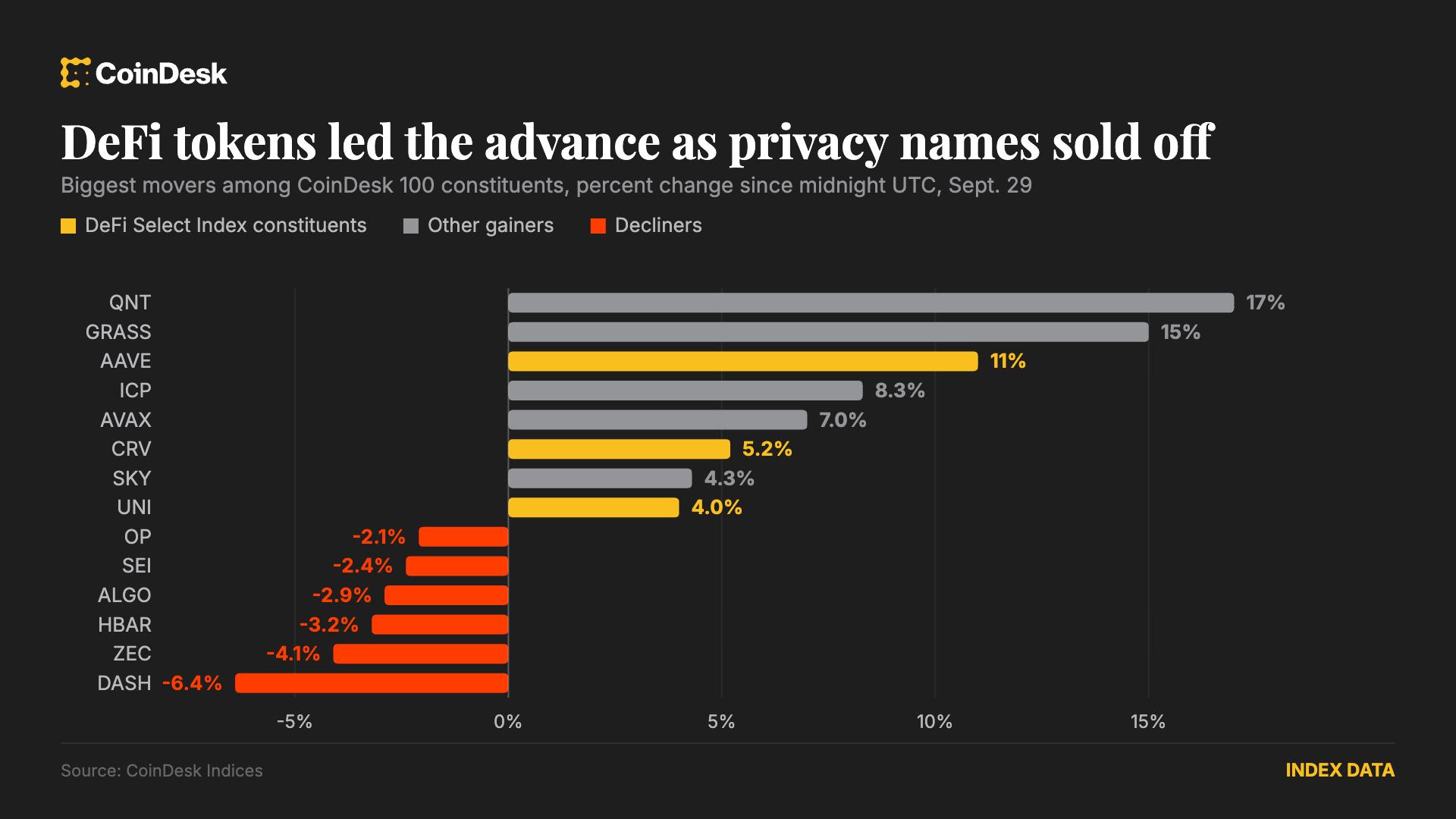
Aave jumped 11% on speculation over a token burn, with 72 of 100 CoinDesk 100 constituents higher even as the 10-year Treasury yield sat at 5.234%.
Bitcoin BTC$84,117.13 recovered Monday's losses to trade at $84,170 on Tuesday, up 0.82% since midnight UTC and 1.4% over 24 hours, with 72 of the 100 CoinDesk 100 constituents higher and the index adding 0.89% to 1,904.49.
The bid is arriving despite conditions that have been suppressing risk assets for a week, the 10-year Treasury yield sitting at 5.234% after ending Monday above 5.2%, near levels last seen in 2007, and the 30-year at 5.549% having topped 5.56% on Monday, around a 2004 high.
U.S. stocks fell for a second session on Monday, the Dow dropping more than 300 points and the S&P 500 and Nasdaq Composite shedding 0.8% and 0.9%, with futures mixed on Tuesday morning.
Decentralized finance (DeFi) is driving the move for the second time in a week, with the DeFi Select Index (DFX) gaining 5.0% since midnight, led by lending protocol token aave AAVE$149.48 at 11% and curve dao token CRV$0.3457 at 5.2%. The CoinDesk 80 rose 2.0% against the CoinDesk 5's 1.3%, though the ranking inverts over 24 hours, where the CD5's 1.7% beats the CD80's 0.44%.
Privacy tokens are the exception and the sharpest decliners, zcash (ZEC) tumbled 4.1% to $1,422.35 and 8.4% over 24 hours, and dash DASH$65.39 6.4% to $61.38, extending a retreat that has taken zcash roughly 13% below where it traded on Friday.
Brent crude eased 0.85% to $97.92, holding below $100 after Monday's spike, while gold added 0.68% to $4,140 and the dollar index firmed 0.18% to 101.36.
As stablecoins move into regulated finance, APAC is becoming a key proving ground. This report maps the region’s rules, use cases, and RLUSD’s role.
Asanat Analysis — Why it matters
Aave's 11% rally on burn speculation reflects a structural divergence between DeFi asset performance and macro headwinds. A 5.23% 10-year yield typically pressures risk assets by increasing opportunity cost of non-yielding crypto holdings, yet 72% of CoinDesk 100 constituents rallied—suggesting either tactical positioning ahead of potential protocol-level value captures (like token burns) or a decoupling narrative taking hold among professional traders.
Token burn mechanics address DeFi's fundamental tension: governance tokens lack inherent cash flows, making deflationary mechanics the primary lever for supply-side value accretion. Aave's case illustrates how protocol revenues from liquidations and borrowing fees can fund buybacks, contrasting with traditional markets where rising rates directly compress valuations. The breadth of gains across 72 constituents implies market-wide recognition that DeFi yields (borrowing rates, liquidation spreads) may benefit from elevated macro rates, creating a countercyclical narrative to traditional risk-off environments.