AI Crypto Tokens Take South Korea by Storm, Overtaking Ripple XRP
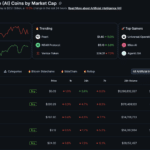
AI-linked cryptocurrencies became South Korea’s leading crypto category by June 2026, overtaking payment-focused assets such as XRP, according to Chainalysis. The finding reflects a shift in retail trading preferences in a space with a long history with Ripple XRP.
Chainalysis examined crypto activity from July 2025 through June 2026, measuring thematic categories by their share of Korean won-denominated trading volume.
East Asia's $1.2T+ crypto economy shows remarkable diversity: South Korea ($449B) leads with an AI-crypto pivot, Hong Kong sees 87% institutional growth, Japan's retail market expands 36% on DEXs, and China's stablecoin P2P wallets grew 43x. Read our new chapter from the 2026…
Against that retail rotation, reports describe an exploratory Ripple–Meritz review of custody and tokenization infrastructure. The key distinction is between changing market narratives and a product actually operating.
That distinction matters for anyone tracking the difference between Ripple’s institutional relationships and confirmed XRP use. The Chainalysis data establish that AI led the defined thematic categories; they do not show that XRP has disappeared from Korean trading or that Ripple’s corporate expansion is translating into token demand.
Chainalysis identified AI cryptocurrencies as South Korea’s most popular thematically defined investment category by June 2026. The report defines this group as assets linked to AI-focused projects or AI infrastructure, and compares categories using their share of won-denominated trading-not a measure of all Korean crypto activity.
The leading AI-linked tokens by reported trading volume were Worldcoin (WLD) at $7.41Bn, SAHARA at $3.2Bn, VIRTUAL at $2.7Bn, BIO at $2Bn, and NEAR at $1.7Bn. The leaderboard has also shifted: VIRTUAL and KAITO led AI-related tokens in 2025 before Worldcoin and SAHARA moved ahead.
Chainalysis said Korean retail traders moved through the AI category faster and more intensely than traders in the other markets it covered. That turnover shows thematic leadership can shift quickly. It describes activity over the report’s measurement period, not a guarantee that any token will retain attention or that every trade represents a long-term investment.
The wider South Korea crypto market also grew during the period. Chainalysis recorded about $449Bn in crypto activity, up 12.3%, while the country’s exchange ecosystem grew 16.3%. Those figures describe overall market expansion; they do not identify XRP as the cause or show that the token shared equally in that growth.
🚨HUGE: South Korea is preparing to bring $7 TRILLION worth stocks, bonds and funds onto blockchain rails from February 2027! $AVAX $XRP
Hanwha Investment & Securities has built a HUGE tokenised securities… pic.twitter.com/DO2Y5C1DLr
In June 2026, South Korea’s AI crypto trading outperformed other currencies, with the won’s share at 19.5 times that of the yen. AI cryptocurrencies accounted for 0.91% of yen-denominated trading, compared with 1.02% for euros, 0.20% for the Brazilian real, and 0.03% for British pounds.
This trend is attributed to South Korea’s involvement in the AI investment cycle, particularly due to SK Hynix, a key memory-chip manufacturer. Retail investors largely drive the market, indicating strong interest in AI tokens.
While AI assets surpassed payment tokens, this does not necessarily mean Ripple XRP has lost significance in South Korea. The ongoing Ripple–Meritz review is still exploratory, lacking confirmation of XRP’s usage or transaction volumes.
Future developments, such as a disclosed product or commercial deployment, will clarify Ripple’s position, while AI-linked assets currently dominate the retail market.
Follow 99Bitcoins on X For the Latest Market Updates and Subscribe on YouTube For Daily Expert Market Analysis.
Established in 2013, 99Bitcoin’s team members have been crypto experts since Bitcoin’s Early days.
Alex is a seasoned cryptocurrency trader and market analyst with over seven years of active experience in the digital asset space. Since entering the markets in 2017, Alex has specialized in identifying emerging "meta" trends and high-volatility narratives. Notably, Alex... Read More
Asanat Analysis — Why it matters
South Korea's pivot toward AI tokens over XRP signals a generational shift in retail crypto preference from payment-infrastructure narratives to applied AI utility narratives. This matters because South Korea has historically been a leading indicator for global retail sentiment—the market that early-adopted Kimchi premium dynamics and drove altseason volatility. A sustained preference for AI tokens suggests the market has matured past pure settlement-layer narratives and is pricing in speculative value around AI tokenomics, regardless of fundamental traction.
The displacement of XRP—which maintains significant Korean institutional presence and remittance use cases—by AI tokens indicates sentiment is driven by momentum and narrative strength rather than use-case maturity. This risks concentration risk: AI token market caps often rest on developer communities and inference/training partnerships that remain nascent compared to XRP's established corridors. If the AI narrative cools or key projects face execution challenges, Korean retail could face significant repricing, which historically cascades into broader market contagion given the region's leverage and position sizing habits.