Asian stocks tumble, bitcoin retreats as China enters bear market
Technology shares led regional losses as mixed U.S. earnings unsettled investors and Brent crude climbed above $112 a barrel.
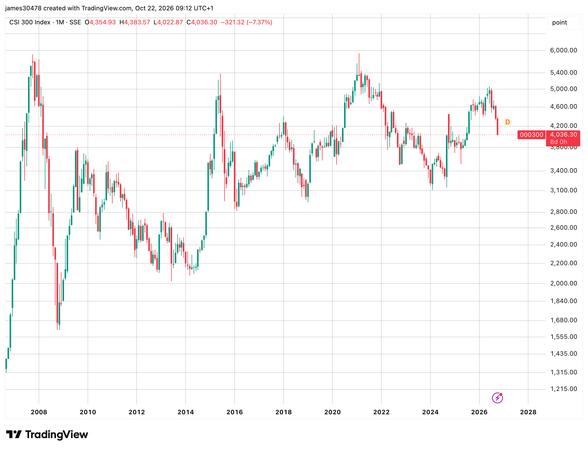
Asian stocks tumbled on Thursday, with Chinese equities entering a bear market as technology shares sank and rising oil prices compounded investor concerns.
The CSI 300, which tracks the 300 largest stocks traded in Shenzhen and Shanghai, slid 2%, taking the decline from June’s peak to 20%. Other regional benchmarks followed suit. Japan’s Nikkei 225 fell around 3%, South Korea’s Kospi dropped 3.5%, Taiwan’s benchmark lost 2% and Hong Kong’s Hang Seng declined 3%.
Chinese technology shares traded in Hong Kong faced their worst session since President Donald Trump’s April 2025 “Liberation Day” tariff announcement, according to Bloomberg’s David Ingles.
According to Ingles, the technology benchmark has fallen more than 40% from its peak, almost erasing gains following Beijing’s Sept. 24 stimulus package, with forward valuations compressed to roughly 13 times earnings.
Mixed third-quarter earnings reports from U.S. companies added to the uncertainty surrounding artificial intelligence investment. Tesla TSLA fell around 3% after the market closed after cutting its capital-spending forecast, while Meta Platforms META raised the lower end of its spending guidance.
Bitcoin BTC$84 459,46 gave up its advance above $84,000, retreating toward $82,000. Gold fell more than 1% to below $4,100 an ounce, while silver dropped over 3.5% to around $55. Nasdaq 100 index futures declined almost 2%.
The Cboe Volatility Index, or VIX, jumped 10% to around 18, roughly 30% above September’s low. Meanwhile, WTI crude topped $100 a barrel and Brent crude climbed above $112 to the highest levels since May.
The equity selloff persisted despite easing Treasury yields, which would tend to make stock-market investments more attractive. The U.S. 10-year yield stood near 5.077%, below its recent peak around 5.4%.
Diversified RWA stablecoins sustain 5-7% yield from real credit as crypto funding compresses to ~4%. GENIUS pushes yield off-chain; TAM grows to $4B in 3 years.
Asanat Analysis — Why it matters
China's bear market entry signals macro regime shift with spillover effects into crypto. When the world's second-largest economy enters technical bear territory (20%+ decline), it typically correlates with reduced risk appetite across digital assets, particularly among Asian retail and institutional investors who've historically driven Bitcoin and altcoin demand. The concurrent retreat in Bitcoin suggests the market is pricing in reduced liquidity from Asia-Pacific sources and potential deleveraging cascades.
The coupling of tech stock weakness with crude above $112/barrel indicates stagflationary concerns—growth stalling while input costs rise. This dynamic typically pressures risk assets including crypto, but can paradoxically support Bitcoin as an inflation hedge if equities continue deteriorating. The mixed U.S. earnings data suggests earnings-per-share growth is decelerating, reducing the opportunity cost of holding non-yielding assets like Bitcoin relative to equities. Watch whether this becomes a multi-quarter trend or near-term volatility.
The broader signal: crypto's correlation with risk-on equities (particularly tech) remains structurally intact despite narratives of Bitcoin's uncorrelated store-of-value status. This bear market episode will likely reinforce the sector's macro-dependent positioning and highlight the importance of regulatory clarity in Asia as a growth lever during downturns.