Bitcoin bears pay to bet on further declines as futures positions near yearly lows
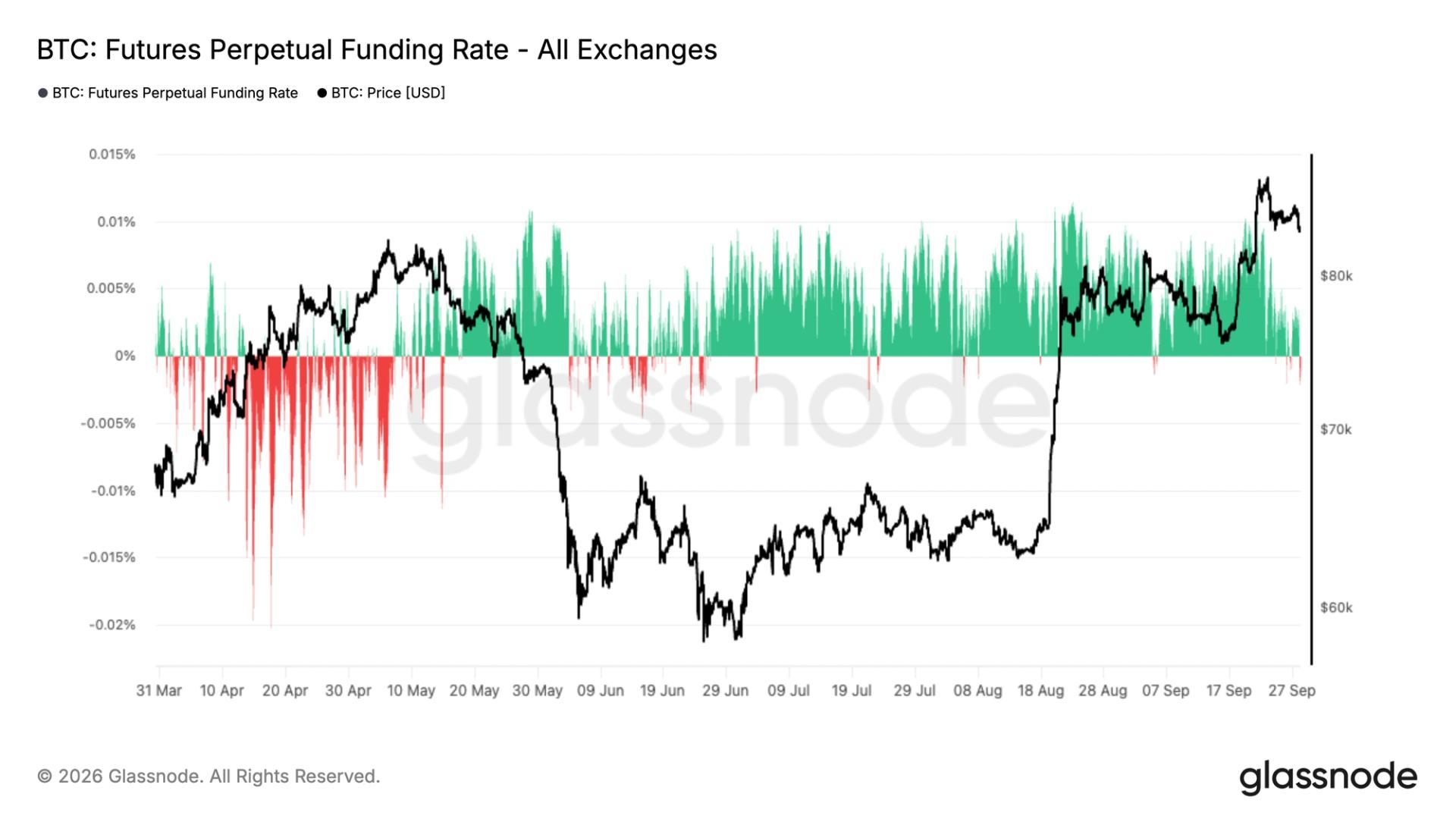
Overall demand for leveraged exposure remains weak, marked by sliding futures open interest. The capital that's still in the market appears skewed toward bearish positions.
Capital is fleeing the bitcoin BTC$82,742.29 futures market, and the traders still in are willing to pay to stay short.
That’s the message from key metrics such as open interest and annualized perpetual funding rates.
Open interest, or the number of active futures bets, stood at 652,000 BTC as of this writing, one of its lowest levels this year. The tally peaked at 800,000 early this year, according to data source Coinglass.
The slide reflects a capital exodus, characterized by traders staying away from leveraged plays despite the 40% rise in bitcoin’s price in the third quarter.
Further, perpetual funding rates have again flipped negative, hovering at an average of minus 0.3% across major exchanges. While every long is matched by a short, the two sides do not want the trade equally. This is where funding rates help. A negative rate shows that short sellers are the ones aggressively chasing the trade and are willing to pay a cost to longs or bulls to keep their bearish bets open.
This follows a 2% bitcoin price drop to $82,800 24 hours after President Donald Trump declined to rule out further strikes on Iran before the U.S. midterm elections.
However, bitcoin is still more than $20,000 above its summer cycle low and is still the best performing asset of the third quarter.
Gold is also down 3% over the past 24 hours, trading around $4,150 an ounce. The bitcoin to gold ratio, which measures how many ounces of gold one bitcoin can buy, is approaching 20 which is on the verge of going positive for the year.
Meanwhile, the DXY index, which measures the dollar against a basket of major currencies, has climbed above 101, as U.S. Treasury yields continue to rise. The 10-year yield is above 5.2%, while the 30-year yield is above 5.51%.
A resilient U.S. economy may be supporting both the dollar and yields, although stubborn inflation concerns could also be pushing borrowing costs higher. Higher yields mean lower prices for bonds: TLT, an ETF holding long-dated US Treasuries, has fallen to around $79, an all-time low.
Rising yields also make interest-bearing assets more attractive relative to bitcoin and gold, which pays no income.
As stablecoins move into regulated finance, APAC is becoming a key proving ground. This report maps the region’s rules, use cases, and RLUSD’s role.
Asanat Analysis — Why it matters
Bitcoin futures open interest declining to yearly lows signals weak conviction across both bullish and bearish traders—a marker of market indecision rather than bearish dominance. When leverage unwinds broadly, it typically precedes volatility spikes in either direction, as thin liquidity amplifies moves. The fact that remaining capital skews bearish despite overall weakness suggests the bears paying for downside exposure may be hedgers (spot holders protecting positions) rather than speculative shorts, which is structurally different.
This positioning has historical parallels: in early 2023 and mid-2024, similar periods of declining OI with bearish skew preceded sharp reversals. The cost of bearish leverage (funding rates, options premiums) rising while open interest falls indicates market makers charging fear premiums into low-volume conditions. For the sector, this reflects post-summer consolidation where retail interest has waned but institutional positioning remains unclear—a precondition for either sustained range-bound trading or sharp directional breakouts.