Bitcoin diverges from South Korean stocks as AI concerns deepen the Kospi selloff
South Korea’s chipmakers lead another sharp selloff as concerns over AI spending and Chinese competition grow, while bitcoin holds well above its summer lows.
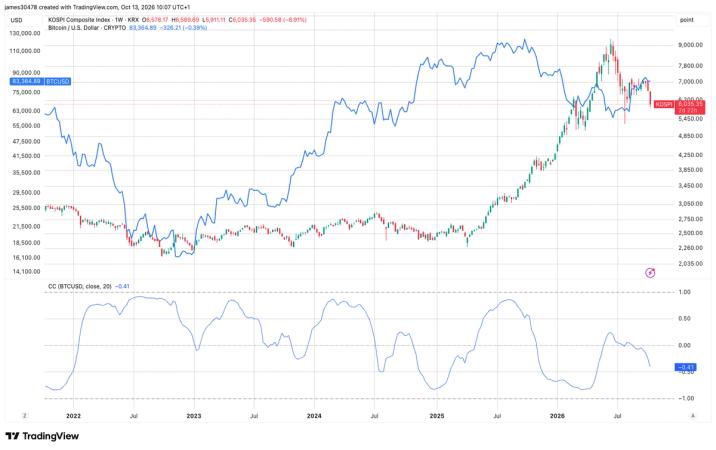
South Korea’s stock market suffered another sharp selloff on Tuesday, with the KOSPI falling 5.5% during Asian trading. The index is now roughly 38% below its June all-time high, extending a reversal that contrasts with bitcoin’s 40% recovery.
Bitcoin bottomed near $58,000 shortly after the KOSPI peaked and has since rebounded as high as $87,000. The weekly chart shows a 20 day-period rolling correlation of -0.41, indicating a moderately negative relationship between bitcoin and the KOSPI.
That divergence suggests that bitcoin could benefit as investors reduce exposure to the AI trade, although correlation alone does not establish capital rotation.
The latest selloff followed comments from Broadcom (AVGO) CEO Hock Tan likening speculative AI investing to gambling in a casino, according to the Financial Times. His remarks intensified concerns about whether the industry can generate returns sufficient to justify enormous infrastructure spending. In addition, advances by Chinese memory-chip rival CXMT added to fears about competition and the durability of chipmakers’ margins, according to Bloomberg.
SK Hynix and Samsung Electronics fell around 10% and 7%, respectively. The weakness has extended into U.S. premarket trading, with memory and storage chipmakers Micron Technology (MU) and SanDisk (SNDK) both down around 3%.
Diversified RWA stablecoins sustain 5-7% yield from real credit as crypto funding compresses to ~4%. GENIUS pushes yield off-chain; TAM grows to $4B in 3 years.
Asanat Analysis — Why it matters
Bitcoin's resilience amid South Korean equity turmoil reflects a decoupling that has become pronounced during regional economic shocks. While the Kospi has absorbed substantial losses driven by chipmaker underperformance—a sector historically sensitive to global tech spending cycles—BTC has maintained price stability relative to summer volatility floors. This divergence underscores how crypto assets, particularly bitcoin, increasingly function as non-correlated hedges during localized financial stress, even when that stress originates in tech-heavy economies.
The AI-spending headwinds and Chinese competition cited as selloff drivers reveal structural pressure on semiconductor valuations that won't quickly resolve. South Korea's chip exporters face margin compression from both overcapacity cycles and geopolitical trade dynamics. Bitcoin's decoupling here is notable because it historically tracked risk sentiment alongside equities; the sustained separation suggests institutional capital may be rotating defensively into uncorrelated stores of value rather than liquidating risk assets uniformly. This pattern has material implications for how crypto correlations evolve through a potential global growth slowdown.