Bitcoin ETF flows turn positive for 2026 after erasing $5.8 billion deficit
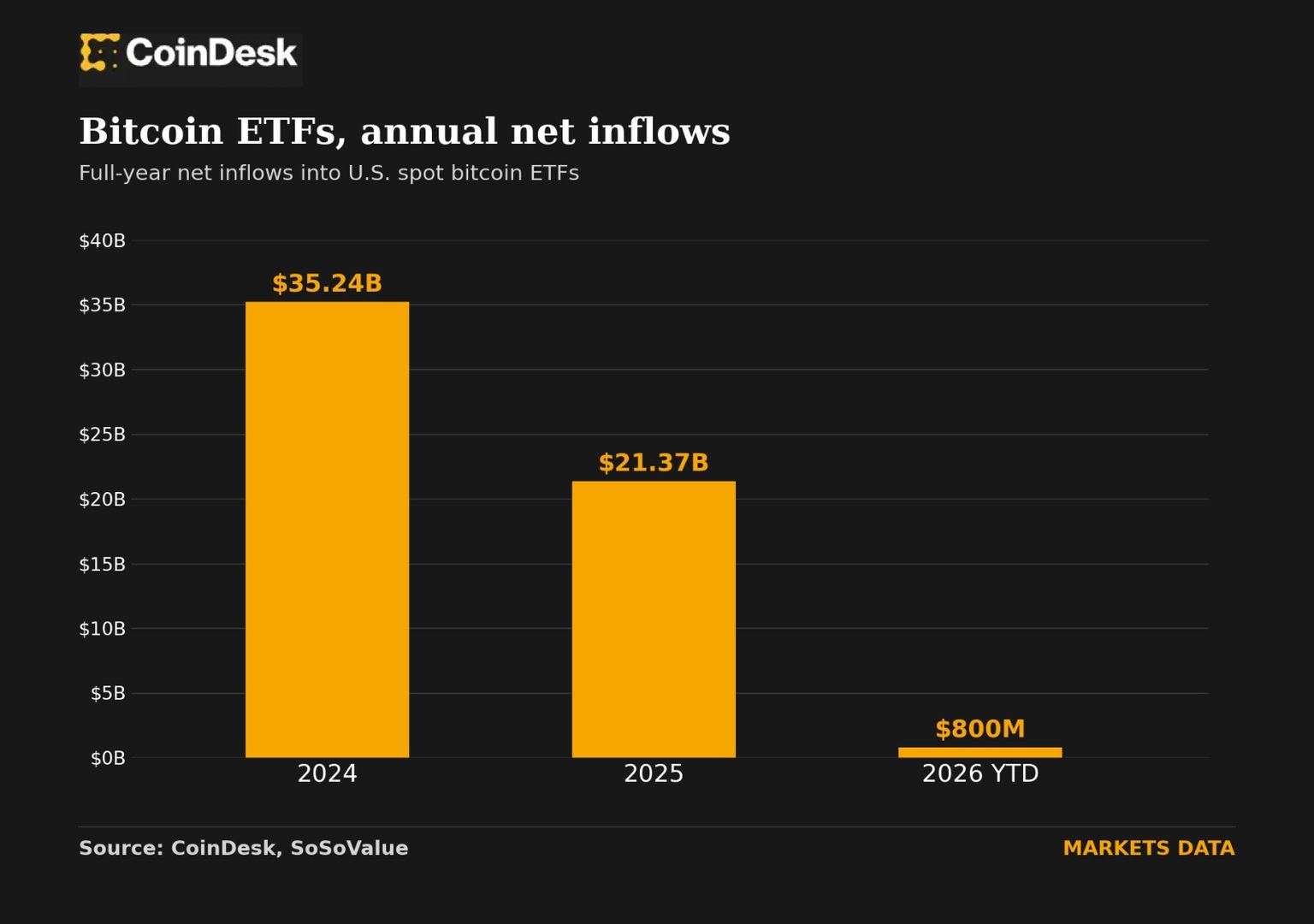
At one point in July, ETFs were down $5.8 billion in net outflows for the year. Now, that’s turned into $800 million in net inflows.
They've poured billions into U.S.-listed spot bitcoin exchange-traded funds (ETFs) in recent weeks. The result: these ETFs now sit on nearly $800 million in net inflows for the year, according to data source SoSoValue. That's a 180-degree turn from the red ink earlier this year.
Here's how bad it got. On July 13, the same ETFs were down $5.8 billion for the year. That was the low point, according to data analyzed by CoinDesk.
The turnaround lines up with bitcoin's price recovery to $85,000 from under $58,000 in early June. That price rise, combined with the ETF inflows, has convinced some analysts a new bull run is already underway.
Nearly $4 billion of those inflows have come in since U.S. Treasury Secretary Scott Bessent's August announcement of increased bond purchases, a liquidity management tool rolled out as bond yields surged to multi-year highs.
Still, there is much work to do for the bulls. At $800 million, net inflows for the year are still way smaller than $35.2 billion in 2024 and $21.4 billion in 2025.
These ETFs have pulled in money for six straight days, even as bitcoin's rally has stalled above $85,000 since Tuesday.
In six days, the funds have attracted $2.84 billion. Impressive, sure. But it loses some shine next to the only two other six-day streaks on record.
One ran from Feb. 22 to 29, 2024, and brought in $2.35 billion. The other, from Nov. 6 to 13, 2024, pulled in $4.73 billion, nearly double what just happened.
As stablecoins move into regulated finance, APAC is becoming a key proving ground. This report maps the region’s rules, use cases, and RLUSD’s role.
Asanat Analysis — Why it matters
Bitcoin spot ETFs have shifted from sustained outflow pressure to inflow territory, erasing a $6.6 billion swing since July. This reversal matters because it indicates institutional capital has returned after months of redemption pressure, likely tied to macro sentiment shifts (Fed policy expectations, market risk appetite). The $5.8B deficit was the deepest drawdown since ETF launches in early 2024, signaling a meaningful test of institutional conviction.
The inversion from persistent outflows to positive flows suggests the market has repriced Bitcoin's risk-reward, possibly driven by either macro de-risking concerns or renewed confidence in crypto valuations. However, this doesn't represent organic capital growth—it's a reversal of prior redemptions, meaning the ETF base is still smaller than earlier 2025 peaks. Sustained inflows would signal fresh institutional accumulation; redemption reversals mainly indicate prior sellers have stopped selling.
For the broader market, ETF flows function as a leading indicator of institutional positioning. A sustained positive inflection through year-end would validate narratives of institutional re-engagement, while another reversal would suggest fragile confidence. The significance lies in what comes next, not the reversal itself—consistency matters more than direction shifts.