Bitcoin ETF investors head for the exit, and it's the biggest rush in months
Your day-ahead look for Oct. 8, 2026
This is an excerpt from CoinDesk newsletter 'Daybook.' Sign up here, if you haven't already.
Just 24 hours after analysts said big inflows into spot ETFs are required to lift bitcoin BTC$82,388.06 meaningfully above $87,000, a level that has limited gains lately, data shows sentiment went in the opposite direction.
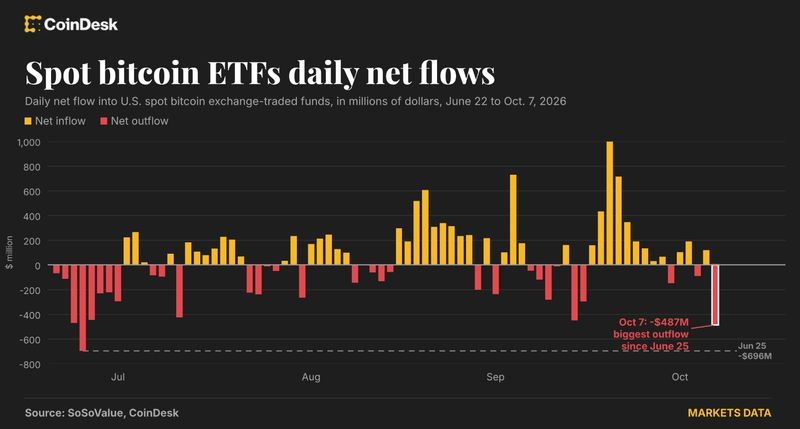
On Wednesday, the U.S. spot ETFs registered net outflows of $487.1 million, the most since June 25, according to data source SoSoValue.
Flows have turned choppy recently. After about $2.65 billion of net inflows in September, October is down $165.6 million so far. The past six sessions have swung between small inflows and outflows.
Wednesday's outflow was unusually large, some 2.1 standard deviations below the average daily flow of the past 90 days, which has been roughly $92 million in inflows, according to data analyzed by CoinDesk. In a normal distribution, roughly 95% of observations fall within two standard deviations of the mean. A larger move represents a rare or unusually large event.
So far this year, the funds have taken in a net $717 million, which is only a thin cushion over zero, especially after the cumulative net flow bottomed at an outflow of $5.76 billion in July. Net inflow since the funds began trading in January 2024 stands at $57.33 billion.
For now, bitcoin is trading around $83,000, flirting with the price floor that has held since the rally stalled on Sept. 21. Analysts have said that a sustained break lower would expose $80,000 and violate the steady bullish stair-step pattern on the daily chart.
"The $80.5K–$81.5K range encompasses last month's local highs and the 50-day moving average. It may not be difficult for the bears to push the price into this area. It is also worth keeping a close eye on whether this attracts bargain hunters or forces buyers with margin positions to capitulate,” Alex Kuptsikevich, chief market analyst at FxPro, said in an email.
“In the former case, we can expect a rapid retest of the highs; in the latter, a sharp drop, like a high-speed lift, to $76K (recent lows) or $72K (the 200-day MA)," he added.
Volatile Treasury notes remain a potential source of headwind, along with potential escalation of tensions between the U.S. and Iran and the resulting oil price spike. Amid all this, weakening spot ETF inflows, which were a major bid during the August-September rally, could prove costly. Stay alert!
Read more: For analysis of today's activity in altcoins and derivatives, see Crypto Markets Today. For a comprehensive list of events this week, see CoinDesk's Crypto Week Ahead.
The chart shows bitcoin’s daily price swings in candlestick format since July. Overlaid is the average price over 50 days, represented by the yellow line.
BTC is currently trading near the lower end of the recent consolidation pattern. A break lower would confirm a bearish resolution to the consolidation, potentially yielding a selloff to the 50-day average at $80,550.
As stablecoins move into regulated finance, APAC is becoming a key proving ground. This report maps the region’s rules, use cases, and RLUSD’s role.
Asanat Analysis — Why it matters
Bitcoin ETF outflows signal a shift in institutional sentiment after months of accumulation. The October 2026 timing is notable—historically, Q4 volatility and year-end positioning triggers tactical reallocation. Unlike retail panic sells, institutional redemptions through spot ETFs carry structural weight: these are large holders making deliberate exits, often linked to profit-taking or rotation into alternative assets or equity hedges ahead of macro uncertainty.
The 'biggest rush in months' framing suggests this breaks a sustained inflow trend, which would be significant given spot BTC ETF adoption as core institutional infrastructure since 2024. Redemptions at this scale may reflect: (1) rotation to higher-yield opportunities as rates stabilize; (2) rebalancing before potential regulatory shifts; or (3) hedging against broader risk-off sentiment. The counter-narrative worth tracking: whether this is healthy profit-taking or signals erosion of institutional conviction in near-term price direction.
For the broader ecosystem, ETF flows remain a key liquidity proxy. Large outflows can compress on-chain activity if they represent net liquidation rather than redeployment. Watch whether staking and DeFi protocols see corresponding inflows—a shift that would indicate capital rotation rather than flight.