Bitcoin holds $83,000 as ZEC drops 12% and oil climbs again
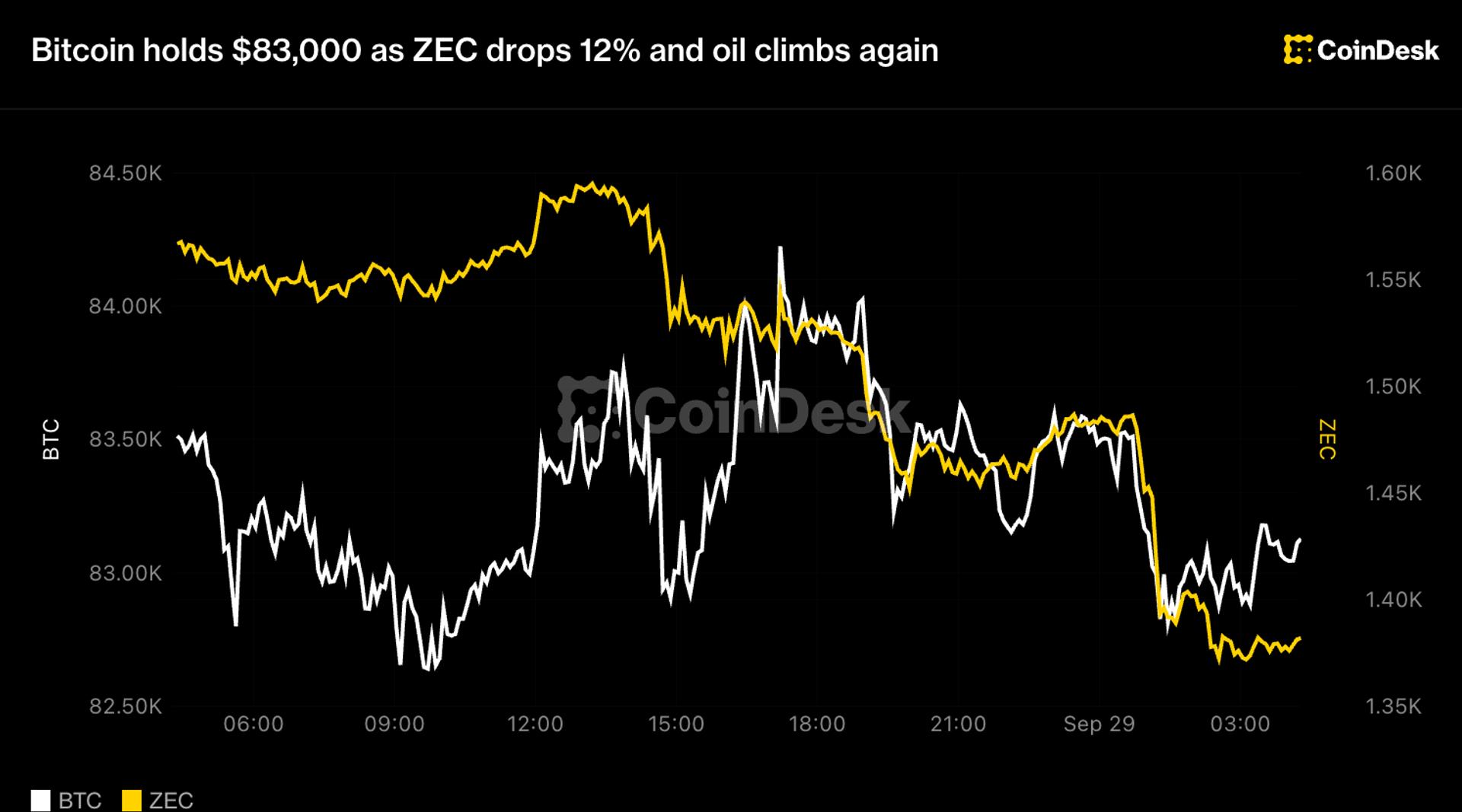
Global stocks fell to a one-week low as Brent rose for a second day and traders added to bets on more Federal Reserve rate hikes ahead of Wednesday's PCE inflation data.
Bitcoin slipped under 1% to just above $83,100 as of Tuesday Asian morning hours, testing the floor of last week's range, after the 10-year Treasury yield touched its highest level since 2007.
ZEC fell 12% to about $1,380, the steepest drop among major tokens, CoinDesk data show. SOL and HYPE each lost between 3% and 4%, DOGE fell 3% and BNB 2%, while XRP dropped nearly 2%. Ether and TRX were flat.
Among smaller tokens, The Graph's GRT jumped 18% and Immutable's IMX nearly 10%, according to FxPro, while UNI and BCH each fell about 10% and DASH lost 7%. Total crypto market value sat near $2.86 trillion.
A widely watched crypto sentiment index stood at 74 out of 100 on Monday, just short of the "extreme greed" zone, a metric that brokerage FxPro contrasted with the fear that has gripped the stock market for the past 20 days.
"Bitcoin has pulled back to $83K, testing the lower boundary of last week's consolidation range,” Alex Kuptsikevich, chief market analyst at FxPro, said in an email to CoinDesk. “As with the market as a whole, a retest of the $82K region, where peaks were formed in May and early September, is entirely to be expected under current conditions.”
"Looking ahead, a sustained return to prices below $80K would be an important signal that the market is not ready to move higher for some time yet. If, however, this consolidation is soon followed by a new bullish momentum, it could send the leading cryptocurrency well above $90K," he added.
Treasuries steadied in Asia after tumbling during U.S. trading, with the 10-year yield up one basis point to 5.25% after reaching its highest level since 2007 on Monday. A higher guaranteed return on government debt raises the bar for holding assets that pay no income, bitcoin among them.
Brent rose more than 1% to nearly $107 a barrel, its second straight gain, as hopes for an imminent diplomatic breakthrough with Iran faded.
Pricier oil feeds into inflation, and traders have been adding to bets that the Fed will raise rates again. MSCI's All Country World Index fell to its lowest since Sept. 18, and Nasdaq 100 futures slipped 0.3% after Monday's tech-led selloff on Wall Street.
The next read on inflation comes Wednesday, when the Commerce Department publishes August's personal consumption expenditures price index, the gauge the Fed watches most closely — where a hotter-than-expected reading would add to rate-hike bets and push Treasury yields higher still, the pressure behind bitcoin's pullback from above $87,000.
As stablecoins move into regulated finance, APAC is becoming a key proving ground. This report maps the region’s rules, use cases, and RLUSD’s role.
Asanat Analysis — Why it matters
Bitcoin's consolidation at $83K amid broader macro headwinds signals resilience relative to equity volatility, though the catalyst appears exogenous rather than fundamental. The sell-off in risk assets—driven by rising oil and Fed rate-hike expectations—typically pressures crypto, yet BTC's stability suggests either accumulation at support levels or a decoupling narrative taking hold ahead of PCE data Wednesday. This data point is critical: hotter-than-expected inflation could extend the Fed's hawkish stance, potentially extending the rate-hike premium that has historically weighed on speculative assets.
ZEC's 12% drop warrants separate analysis. Zcash has consistently underperformed broader crypto markets during periods of regulatory scrutiny or macro tightening, as privacy-focused assets face headwinds from both institutional adoption concerns and tighter monetary conditions. The divergence between BTC stability and ZEC weakness suggests sector bifurcation: core assets (BTC, ETH) may be treated as macro hedges by large players, while smaller-cap altcoins absorb liquidity pressure more acutely.
The resurgence of oil prices (Brent climbing) introduces second-order implications: traditional risk-off environments often suppress crypto demand from retail and leverage-constrained traders, yet energy cost concerns may intermittently elevate Bitcoin's digital-commodity narrative. Wednesday's PCE release will likely reset market expectations across all assets; a miss below consensus could stabilize equity markets and reduce BTC's safe-haven premium.