Bitcoin rebounds above $83,000 as it decouples from tumbling Korean stocks and Nasdaq futures
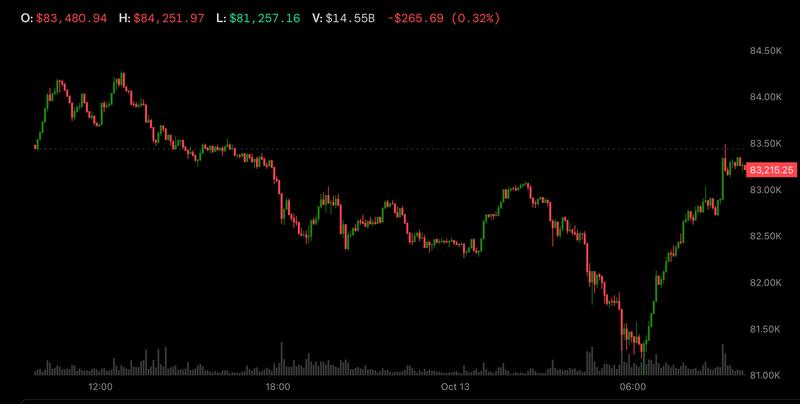
Bitcoin climbed back above $83,000 after an early dip, decoupling from a sharp slide in Korean chip stocks and weakness in Nasdaq futures ahead of Thursday’s US CPI report.
Bitcoin BTC$82,292.69 climbed back above $83,000 on Tuesday, shaking off an early drop as a sharp selloff in Asian chip stocks and U.S. tech futures weighed on risk appetite.
The largest cryptocurrency by market value fell to just under $81,000 at 00:50 UTC before recovering above $83,000, according to CoinDesk data. Ether ETH$2,510.30 bounced from five-day lows, while XRP (XRP) turned higher after touching three-week lows. Zcash (ZEC), solana (SOL) and several other major tokens followed a similar pattern.
The early crypto weakness came as South Korea’s KOSPI plunged more than 6% intraday, falling below 6,000 and hitting its lowest level since late July. The index remained down roughly 6% in morning trade.
Chipmakers led the rout. Samsung Electronics and SK Hynix each fell roughly 8%, extending their losing streaks to five sessions. Investors were rattled by concerns over AI-related valuations and rising competition from Chinese memory-chip producers.
Hong Kong’s Hang Seng slipped 0.4%, while Nasdaq futures fell 0.6%, extending Monday’s 0.78% decline in the tech-heavy index.
WTI crude traded near $92.67, holding most of Monday’s sharp recovery from below $90. Fresh attacks in Saudi Arabia and continued threats to shipping through the Strait of Hormuz have kept energy-market uncertainty elevated.
Brent crude hovered around $106 a barrel after a three-day rally, as traders weighed potential supply disruptions against expectations of additional Russian diesel exports.
A higher oil raises inflation risks, strengthening the case for Fed rate hikes, a headwind for crypto.
The Dollar Index, which tracks the greenback’s value against major currencies, held near 102.50, the highest since April last year.
Crypto traders are now looking to Thursday’s U.S. consumer price index report as the next major catalyst. Some expect large investors to increase hedging rather than reduce their crypto exposure.
“With US inflation data approaching, I expect institutional investors to focus on adding protection through derivatives and hedging strategies rather than materially reducing their underlying exposure,” said Paul Howard, senior director at market-making firm Wincent.
“This is typically how committed institutional participants manage periods of heightened risk: maintaining their core positions while using derivatives to protect against downside and continuing to treat cryptocurrencies as an asset class capable of generating returns,” Howard added.
Diversified RWA stablecoins sustain 5-7% yield from real credit as crypto funding compresses to ~4%. GENIUS pushes yield off-chain; TAM grows to $4B in 3 years.
Asanat Analysis — Why it matters
Bitcoin's decoupling from equities—particularly Korean semiconductors and Nasdaq futures—signals a structural shift in how macro risk correlates with crypto. For most of 2024-2025, BTC tracked equity indices closely during volatility spikes. This rebound above $83k despite tech weakness suggests either (1) institutional flows are treating Bitcoin as a genuine uncorrelated hedge again, or (2) crypto participants are pricing in a different CPI outcome than equity traders. The Korean chip selloff is particularly relevant given Samsung and SK Hynix's weight in both semiconductor supply chains and global risk sentiment.
Thursday's US CPI print remains the key macro event determining whether this decoupling holds. If inflation comes in cooler than expected, equities typically rally and BTC follows upward. If hot, both risk assets could sell off—making today's divergence potentially temporary. The timing matters: Bitcoin's technical reclamation of $83k before a major data release is historically bullish for risk assets more broadly, though it doesn't guarantee equities will follow. This also reflects growing maturity in crypto markets, where BTC can trade on its own supply dynamics (halving-cycle positioning, ETF flows) independent of equity momentum for short windows.