Bitcoin stuck near $88,000 as gold's and silver's record-breaking rallies show exhaustion signs
"Gold and silver casually adding an entire bitcoin market cap in a single day," wrote one crypto analyst.
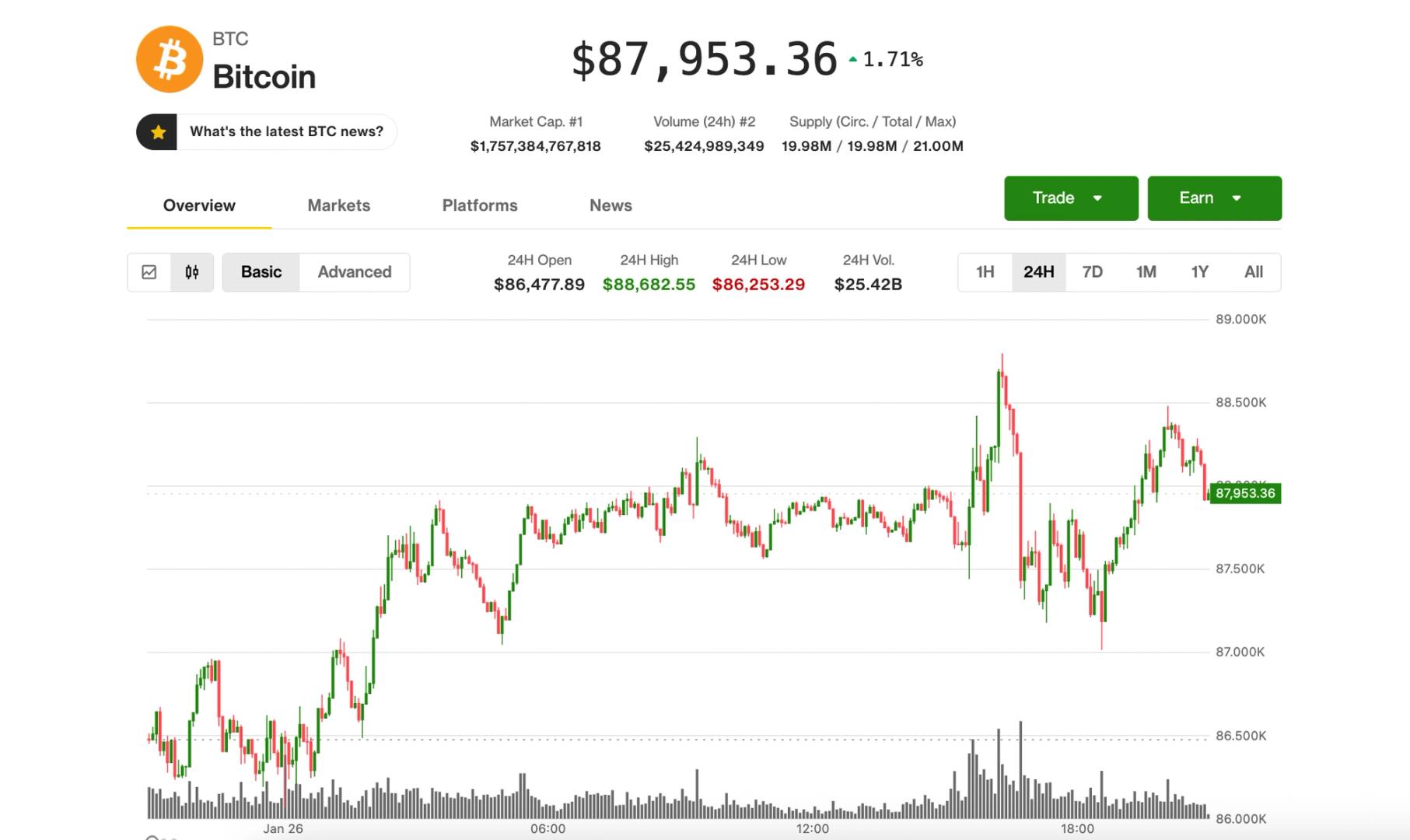
Bitcoin BTC$87,538.76 remained stuck in limbo at around $88,000 on Monday as gold and silver extended their blistering rallies before paring gains.
BTC is up a bit from what's now becoming a renewed pattern of panicky weekend selling, but down from around the $90,000 late Friday. Rising odds of a government shutdown on Jan. 31 — and the crimp on liquidity that might entail — were among the leading reasons for the Sunday selloff.
That exact same news, however, left precious metals bulls unfazed. Gold soared through $5,000 and then $5,100 for the first time ever on Sunday and Monday, while silver raced as high as $118. Exhaustion signs, though, could be setting in. Gold has retreated all the way back to $5,043 — now up 1.3% for the day — while silver has retreated to $108, still higher by 7%.
"Gold and silver casually adding an entire bitcoin market cap in a single day," wrote well-followed crypto analyst Will Clemente, summing up the mood of bitcoin investors.
The U.S. dollar index (DXY) rolled over to its weakest level since September as the U.S. Federal Reserve and Bank of Japan reportedly teamed to intervene in currency markets in an attempt to boost the yen versus the greenback. At 154.07 per yen, the dollar is lower by more than 1% on Monday.
The lack of bullish follow-through in bitcoin despite dollar weakness has turned traders cautious for the near-term, analysts at Swissblock argued. "Recent price action has reinforced the bearish outlook," they said in a Monday note.
A decisive breakdown below the $84,500 support level could open the door to a deeper correction toward $74,000, they warned. Still, they flagged that if this support holds while risk metrics cool off, it could offer a compelling entry point for bulls.
Bitfinex analysts echoed the cautious tone, noting BTC is likely to remain range-bound between $85,000 and $94,500. They also pointed to shifts in the options market, with traders responding tactically to short-term risks without pricing in longer-term volatility.
That means traders are "pricing transitory risk rather than a sustained disruption to market structure," the analysts wrote in a Monday note.
Adding to the pressure is persistent selling from spot bitcoin ETFs. Cumulative outflows exceeded $1.3 billion over the past week, pointing to a lack of risk appetite among investors.
Schwab director of crypto research and strategy, Jim Ferraioli, sees little reason to expect a sustained move beyond current levels without a pickup in metrics such as on-chain activity, ETF flows or derivatives positioning and miner participation.
A more significant catalyst, according to him, is the passage of the Clarity Act, but that could be delayed by the potential for a government shutdown. Until the legislation is passed, he expects narrow trading between the low $80,000s and mid-$90,000s, as major institutional players will remain on the sidelines.
KuCoin captured a record share of centralised exchange volume in 2025, with more than $1.25tn traded as its volumes grew faster than the wider crypto market.
SharpLink CEO Joseph Chalom argues that macro uncertainty is hiding a massive institutional shift toward Ethereum-based tokenization.
The context: Former BlackRock Head of Digital Assets Strategy, and SharpLink CEO, Joseph Chalom says institutional giants are betting heavily on Ethereum to serve as the global infrastructure for asset tokenization, ignoring current price stagnation.He outlines three key drivers for a projected 10x surge in Ethereum activity this year:
Asanat Analysis — Why it matters
Bitcoin's $88k stall contrasts sharply with gold and silver's record-breaking momentum, a divergence that signals weakening risk appetite rather than macro validation of crypto. Both asset classes should theoretically benefit from dollar weakness (DXY at 9-month lows) and Fed policy uncertainty, yet BTC's inability to rally alongside precious metals despite these tailwinds suggests crypto traders are repricing for specific regulatory friction—the delayed Clarity Act and January 31 government shutdown—rather than systemic deleveraging. This selectivity matters: gold can attract passive macro hedgers indifferent to regulation, while crypto remains hostage to U.S. policy clarity.
The cascade of negative signals—$1.3B in spot ETF outflows, exhaustion in precious metals rallies, traders pricing 'transitory' rather than structural risk—points to a market waiting for institutional gatekeepers. Schwab's Ferraioli explicitly ties sustained moves to on-chain metrics and miner participation revival, not just price levels. The Clarity Act becoming a de facto gating function for institutional entry means crypto's floor is now a policy release, not a technical support. If $84.5k fails, analysts flag $74k as the next structural test, a scenario where macro tailwinds prove insufficient without legislative clarity.
Notably, institutional capital appears to be bifurcating: KuCoin's record 2025 volume and reports of Ethereum-focused tokenization positioning suggest activity is shifting toward infrastructure plays capable of serving institutional tokenization use cases. This divergence—macro uncertainty depressing spot demand while concentrated players hedge toward ecosystem-specific bets—explains why BTC stagnation coexists with sectoral repositioning. The narrow $85-94.5k range Bitfinex projects reflects not equilibrium but gridlock pending policy resolution.