Bond volatility surges while bitcoin and Wall Street stay calm
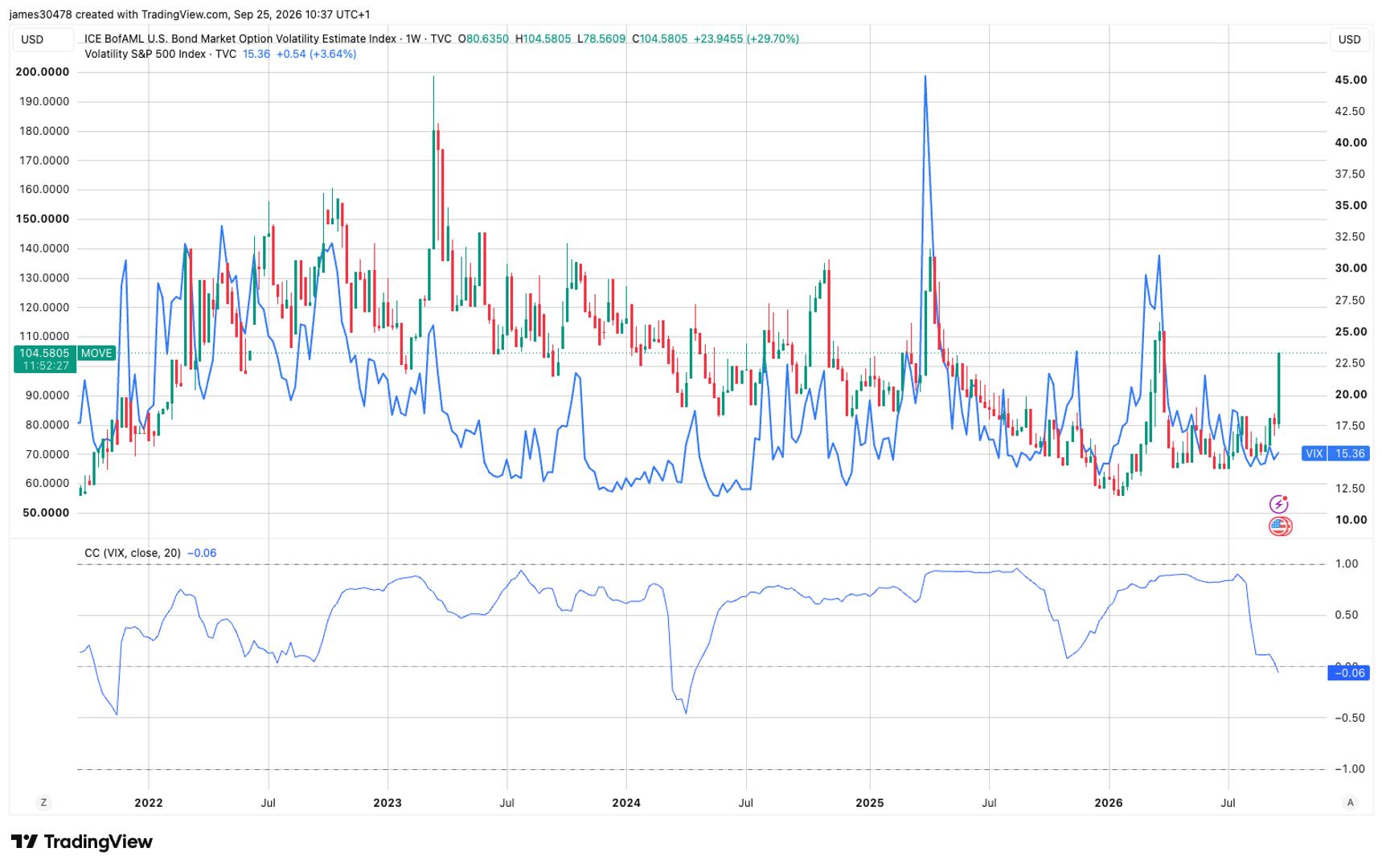
Bond volatility is at its highest since March, while the bitcoin VIX, BVIV and Wall Street's VIX remain near its yearly low.
The bond market is flashing a warning that bitcoin and U.S. stocks have yet to register.
The MOVE index, which measures expected volatility in the U.S. Treasury market, has jumped from around 80 on Tuesday to 104 on Thursday, its highest level since March when it hit 199, according to data source CoinDesk.
Volmex’s annualized 30-day bitcoin implied volatility index, BVIV, is subdued at around 37, close to its year-to-date low of 35. The index reflects bitcoin options traders’ expectations for price volatility over four weeks. Meanwhile, the Cboe VIX, which tracks expected volatility in the S&P 500, is hovering close to its year-to-date low of 14. Neither market is showing the same demand for volatility.
The divergence points to underlying strength in bitcoin and stocks. Higher volatility in Treasury notes, which underpin global finance and credit creation, typically tightens financial conditions and disincentivizes risk-taking in financial markets.
The divergence comes as government bond yields climb globally. The war in the Middle East has driven oil and diesel prices higher, complicating the inflation outlook and raising questions about how much further central banks may need to tighten policy. The U.S. 10-year Treasury yield briefly hit 5.2% on Thursday before easing to 5.163%.
When MOVE was last around this level in March, the S&P 500 stood near 6,350. It has since risen to 7,704, up roughly 21%. However, bond traders are now paying considerably more for protection against swings in interest rates.
Over a 20-day window, the correlation between VIX and MOVE has slipped to −0.06, turning negative for the first time since April 2024, though that reading is close to zero. The correlation between BVIV and MOVE is more clearly negative at −0.37, one of its lowest readings in years. As bond volatility has risen, bitcoin’s expected volatility has remained near its yearly low.
As CoinDesk reported this week, rising yields alone have shown little consistent relationship with bitcoin’s returns.
As stablecoins move into regulated finance, APAC is becoming a key proving ground. This report maps the region’s rules, use cases, and RLUSD’s role.
Asanat Analysis — Why it matters
Bond volatility spikes typically precede equity and crypto repricing cycles. The divergence here—elevated Treasury volatility alongside depressed equity and crypto volatility indices—suggests market participants are pricing duration risk and potential rate path shifts that haven't yet cascaded into risk-asset repricing. This disconnect is historically unstable; when Treasury moves accelerate, correlations tend to reset and VIX compression breaks.
For crypto specifically, a sustained bond vol surge without corresponding BVIX elevation indicates either complacency or genuine decoupling from macro rates. Bitcoin's historical sensitivity to real yields and Fed policy means this calm may reflect market conviction that rate volatility won't translate to liquidity shocks—or it reflects hedging costs making implied vol artificially cheap. The persistence of this gap narrows; similar periods in 2022 and 2023 preceded sharp crypto drawdowns within 2-4 weeks as macro repricing broadened.