Bybit will look for big broker partnerships to take on Robinhood in the U.S.
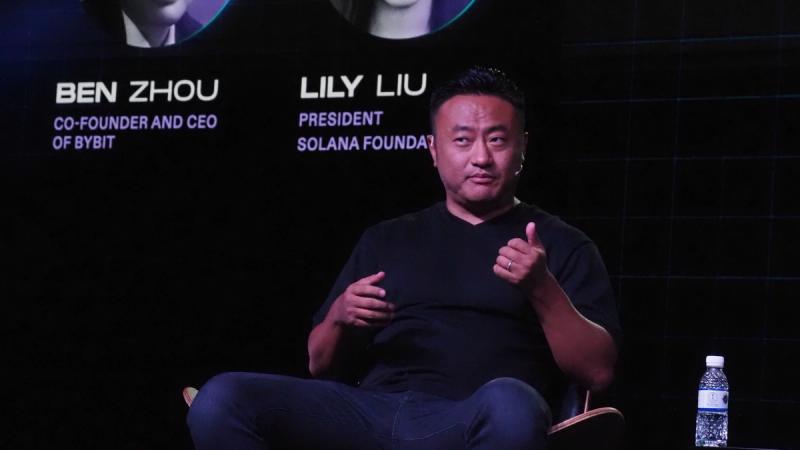
When it comes to the U.S., Bybit will look to work with with someone like Interactive Brokers (IB), for example, said CEO Ben Zhou.
Bybit, the second-largest cryptocurrency exchange by trading volume, plans to buddy up with an established local company when it enters the U.S. to help it challenge the reach of firms like Robinhood Markets HOOD$101.21, according to CEO Ben Zhou.
Zhou said finding a partner is Bybit’s standard approach when entering new territories, suggesting that for the U.S., Bybit will consider working with a company such as Interactive Brokers (IB), for example.
“It’s best at this stage to work with a partner who wants to enter the crypto field and who already has a client base in the U.S.,” Zhou said in an interview. “For example, IB or one of those guys who haven't gone into crypto and have a good U.S. base.”
Bybit, which has in excess of 80 million registered users worldwide across more than 180 countries and regions, has been collecting licenses globally with a view to offering a range of new regulated products. In Europe, for example, it plans to deploy an everything app offering derivatives and tokenized stocks as early as the first quarter of next year.
Bybit’s partnership approach cuts out the onerous alternative, taken by the likes of Coinbase Global COIN$177.05, to cross the U.S. state by state gathering money transfer licenses, culminating in a coveted New York state Bit License.
The state-by-state licensing process would take two to three years, Zhou said. “I might as well just wait for [the] Clarity [Act] to pass or have a better understanding of what the new law is. Maybe the SEC is going to take over, and then it's going to be one regulator, one license, and everything is covered at the federal level.”
The fact that Bybit has not yet attempted to establish a presence in the world’s largest economy is to its advantage, Zhou said.
“Bybit is the only one that's been sitting out of the U.S., and as a result we have a completely clear record there,” he said. “So we can actually go in any time if the moment is right. I think I should use that good record to our advantage and wait for the best moment to enter, rather than rush to FOMO in.”
FOMO, or fear of missing out, can steer people or companies to act in an unconsidered manner that may end up to their detriment.
While the U.S. is a big and hugely important market, it's also highly competitive and very saturated, Zhou said, with the established stature of firms like Coinbase, and the growing importance of Robinhood.
Even Southeast Asia, Latin America, Africa are all pretty competitive, Zhou said. One place where competition is not so concentrated and which remains a “pretty good market,” is the U.K., according to Zhou.
“The U.K. is looking towards a new regime for crypto, and none of the global exchanges are dominant there,” Zhou said. “The player is probably Coinbase. So from a preliminary look, it seems like a very untapped market. But again, the cost to enter is very high and would almost take the same effort as a MiCA license in the EU. But we're looking into it.”
Early this year, Zhou was invited to meet government-linked bodies including the Financial Conduct Authority (FCA) and members of the House of Lords, the parliament’s upper chamber.
Asked if Bybit has a London office, Zhou said: “We're looking, but we haven't decided where yet.”
Diversified RWA stablecoins sustain 5-7% yield from real credit as crypto funding compresses to ~4%. GENIUS pushes yield off-chain; TAM grows to $4B in 3 years.
Asanat Analysis — Why it matters
Bybit's pursuit of U.S. broker partnerships signals a strategic pivot toward regulatory compliance over direct market access—a meaningful shift for offshore exchanges. By partnering with established brokers like Interactive Brokers rather than applying for independent licenses, Bybit avoids prolonged SEC scrutiny while leveraging existing infrastructure and custody solutions. This mirrors how Asian exchanges have entered Western markets post-2023, when regulatory pressure intensified against unregistered derivatives platforms.
The Robinhood comparison is telling: it positions Bybit as targeting retail flow rather than institutional volume. This matters because U.S. spot crypto trading has consolidated around licensed venues (Kraken, Coinbase), making derivatives and leverage the primary differentiator for offshore players. A partnership with IB—which holds substantial regulatory credibility but limited crypto trading volume—creates a supply-side constraint that could benefit existing U.S. exchanges if terms remain restrictive. The strategy also sidesteps the broker-dealer licensing hurdle that has blocked Kraken and others from launching certain U.S. products.