Live updates: Bitcoin tumbles from near $84,000 ahead of U.S. inflation data
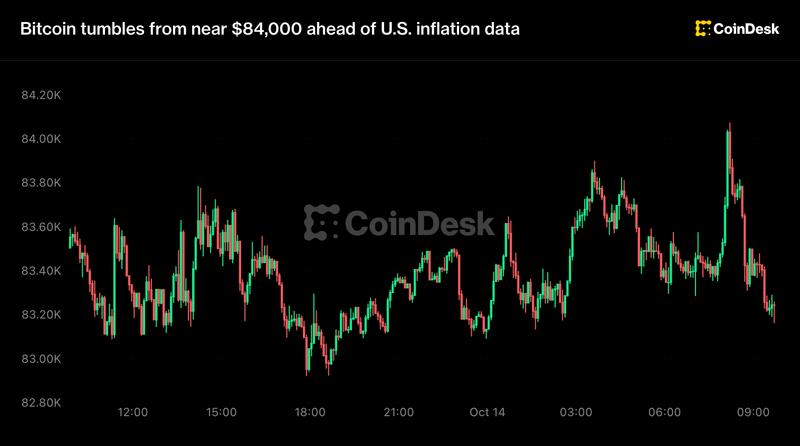
A brief run at $84,000 faded within the hour as tech stocks stalled and the chip selloff rolled on. Traders are waiting on the September CPI print.
A brief spike to $84,000 early Wednesday faded within the hour, leaving bitcoin down 0.5% at about $83,200. It’s still boxed between its 50-day moving average near $81,000 and a ceiling at $84,000.
The 50-day moving average is bitcoin’s average closing price over the past 50 days, and traders watch it for the medium-term trend. Buyers defended it on Tuesday, when bitcoin bottomed near $81,000, but they haven’t managed to push the price through $84,000 since.
ZEC and TRX were the only gainers among the majors, up about 1%. HYPE was the laggard, down 2% to about $81. SOL fell 1.4% and ether slipped 1% to just under $2,500, according to CoinDesk data.
Bitcoin trades close to the Nasdaq 100 in how institutions rank risk, and “the latter’s caution is preventing Bitcoin from spreading its wings,” said Alex Kuptsikevich, chief market analyst at FxPro.
Nasdaq 100 futures were little changed, and an ETF tracking chipmakers pointed to another day of selling even after ASML rose more than 2% in Europe. The chip-equipment maker said it can’t fully meet demand for the next two years. Bank of America and Morgan Stanley report later Wednesday, and forecasts point to the September U.S. inflation report showing a slowdown in underlying prices.
A daily close above $84,000 would be the first sign that buyers have broken out of the range.
Asanat Analysis — Why it matters
Bitcoin's rejection at $84,000 signals risk-off sentiment ahead of macro data, not fundamental crypto weakness. The correlation with tech stocks and semiconductor weakness indicates BTC is trading as a risk asset rather than finding safe-haven bids—a pattern that intensifies when equities face headwinds. CPI prints directly influence Fed policy expectations, which compress or expand risk appetite across correlated asset classes.
The timing matters: September CPI data arrives amid persistent debate over terminal rates and recession probability. A hotter-than-expected print could trigger equity liquidation cascades that pull crypto along, while a cooler reading might unlock a relief rally. Bitcoin's failure to hold $84,000 suggests traders are already pricing in hawkish risk, positioning defensively before the number hits.
This dynamic reinforces a structural reality: BTC remains tightly coupled to macro sentiment and equity market beta, despite narrative claims of decoupling. Until crypto builds its own yield-generating or intrinsic-value narrative independent of tech equities, price action will track risk-on/risk-off cycles driven by central bank policy and inflation expectations.