Morgan Stanley’s Bitcoin Investment Recommendation Explained w/ Amy Oldenburg
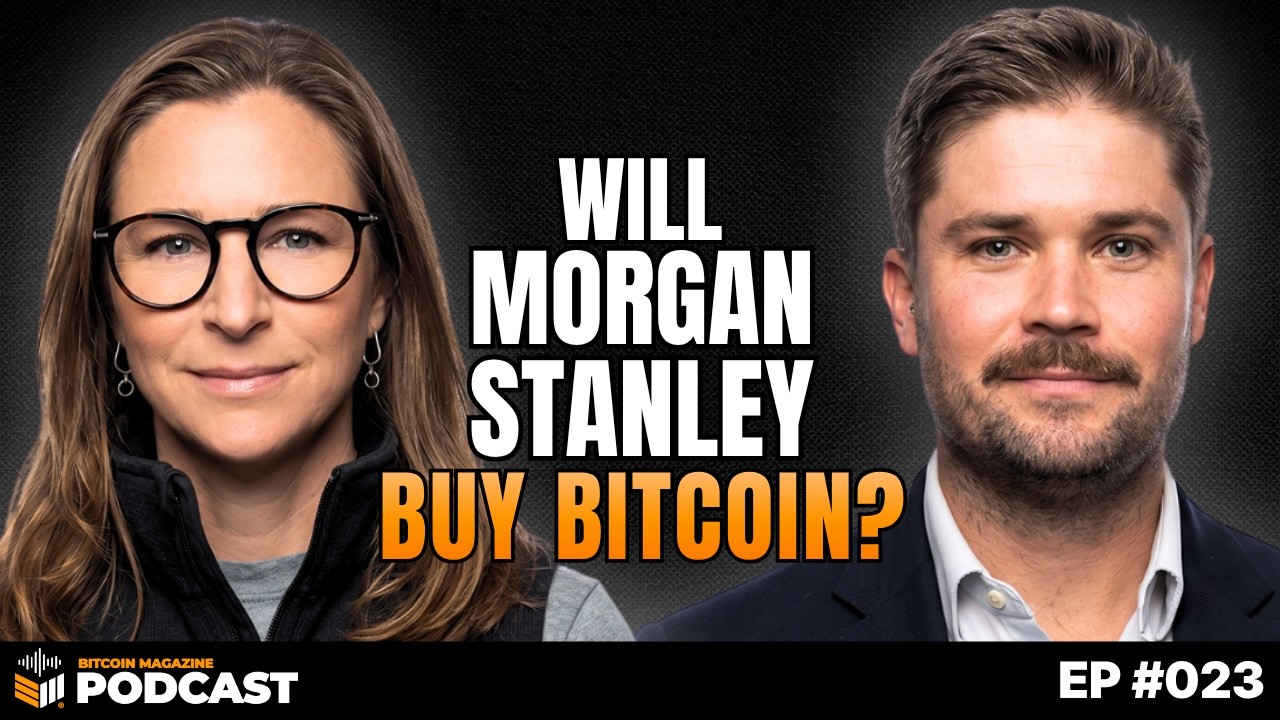
Bitcoin Magazine Morgan Stanley’s Bitcoin Investment Recommendation Explained w/ Amy Oldenburg Morgan Stanley’s Digital Assets Head Amy Oldenburg joins Spencer Nichols to break down their $600M+ spot...
Morgan Stanley’s Digital Assets Head Amy Oldenburg joins Spencer Nichols to break down their $600M+ spot Bitcoin ETP, portfolio models, and more.
Morgan Stanley became the first global systemically important bank to launch a spot Bitcoin ETP and it crossed $600 million within months of its April debut. Amy Oldenburg, Head of Digital Assets at Morgan Stanley, joins host Spencer Nichols to explain how that product came together, why it was priced below competing spot Bitcoin ETFs, and what still stands between clients and their first Bitcoin allocation. She also details the firm’s 0–4% allocation framework across three investor risk profiles and why Morgan Stanley has no equivalent gold allocation. Plus: whether Bitcoin could land on Morgan Stanley’s own balance sheet.
🔶 Host: Spencer Nichols — Bitcoin Magazine🔶 Amy Oldenburg, Head of Digital Assets at Morgan Stanley
Chapters:0:00 — Morgan Stanley on Putting Bitcoin on Its Own Balance Sheet1:14 — 26 Years at Morgan Stanley: Emerging Markets to Head of Digital Assets2:10 — First Major Bank to Launch a Spot Bitcoin ETP Tops $600 Million3:14 — Education, E-Trade Spot Crypto, and What Clients Actually Own4:49 — Why Morgan Stanley Priced Its Bitcoin ETP So Low6:40 — The 0–4% Allocation Framework and the Digital Gold Thesis8:52 — Correlation Regimes: Digital Gold, High Beta Tech, and Volatility11:41 — Gold 2.0, Market Cap, and Bitcoin on the Balance Sheet14:37 — Institutional Market Structure, Quantum Risk, and Client Trust18:02 — Global Off-Ramps, Tokenization, Stablecoins, and Morgan Stanley Research
DISCLAIMER: The views and opinions expressed in this show are those of the participants and do not necessarily reflect the official policy or position of BTC Inc., Bitcoin Magazine, or any affiliated entities. This content is provided for informational and educational purposes only and should not be construed as investment, legal, tax, or accounting advice. Nothing contained in this show constitutes a solicitation, recommendation, endorsement, or offer to buy or sell any securities or financial instruments. Viewers should consult their own advisors before making financial or business decisions.
Asanat Analysis — Why it matters
Morgan Stanley's $600M+ spot Bitcoin ETP crossing a significant threshold within months signals institutional capital infrastructure is maturing faster than regulatory frameworks anticipated. The fact that a systemically important bank priced its product below competitors suggests confidence in volume-based economics rather than premium positioning—a shift from earlier ETF launches where scarcity commanded spreads. This pricing strategy indicates Morgan Stanley expects Bitcoin adoption curves to steepen, prioritizing market share capture over margin extraction on each unit.
The 0–4% allocation framework across risk profiles is directionally important: it institutionalizes Bitcoin as portfolio ballast rather than speculative satellite, echoing the 'digital gold' thesis but with explicit guardrails. Notably, Morgan Stanley has no equivalent gold allocation mentioned, which reframes the question—Bitcoin isn't being positioned as gold replacement so much as a new asset class requiring different risk calculus. The open question of whether Bitcoin lands on Morgan Stanley's own balance sheet remains pivotal; corporate adoption by global systemically important banks would trigger cascading conformity pressure across institutional competitors.
Discussion of quantum risk, stablecoins, and tokenization signals the firm is mapping second and third-order infrastructure buildouts, not just current-state products. This forward-looking posture—particularly around global off-ramps—suggests institutional players are beginning to price in regulatory legitimacy of on-chain settlement and custody models. The emphasis on client education and actual ownership clarification indicates residual friction around self-custody understanding remains a barrier even at this institutional maturity level.