NVIDIA (NVDA) and Palantir Streamline AI Supply Chain with Nemotron
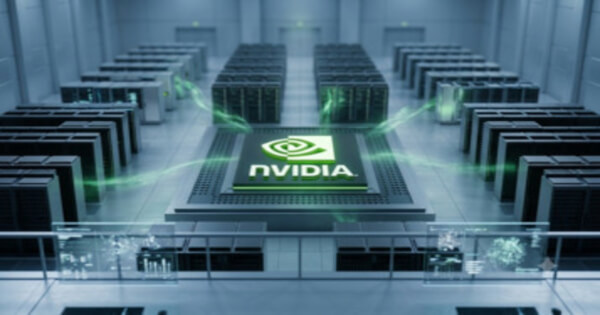
NVIDIA partners with Palantir Foundry to optimize its AI server supply chain using Nemotron models. Key insights on the evolving strategy.
NVIDIA (NVDA) has unveiled a major advancement in its supply chain management strategy, leveraging Palantir Foundry and its Nemotron AI models. The initiative aims to optimize the journey from 'wafer-out' to 'first token,' a critical performance metric for its AI infrastructure business. Given NVIDIA’s $5.43 trillion market cap and its dominance in the AI hardware space, any efficiency gains here could have significant market ripple effects.
At the heart of NVIDIA's supply chain is its Blackwell GPU platform and related AI server systems, which depend on a sprawling, complex network of suppliers and manufacturers. Each rack requires thousands of components, including GPUs, CPUs, and HBM3e memory, sourced globally. Supply constraints, such as advanced packaging capacity at TSMC or high-bandwidth memory availability, have been ongoing challenges, as highlighted in the company’s Q2 FY2027 earnings call.
NVIDIA’s operational team has partnered with Palantir Foundry to develop a Digital Supply Chain Intelligence command center. This system consolidates data from fragmented sources, providing real-time visibility into bottlenecks and risks. By integrating structured and unstructured data into a unified layer called the Ontology, the platform enables NVIDIA to simulate various allocation scenarios and optimize decisions based on real-time constraints. For example, planners can identify whether a shortfall is caused by scarce memory, limited Taiwan manufacturing capacity, or other factors.
The Ontology also serves as the foundation for NVIDIA’s Nemotron AI models, which are fine-tuned to codify human expertise in allocation decisions. This allows planners to move beyond basic optimization by incorporating qualitative factors like geopolitical risks or weather disruptions into their decision-making process.
NVIDIA’s open-weight Nemotron 3.5 Lightning models, specifically post-trained for supply chain scenarios, have demonstrated significant improvements in allocation accuracy. The post-trained model achieved 86.7% accuracy on NVIDIA's decision-intelligence benchmark, far surpassing the 55.5% accuracy of the larger Nemotron 3 Ultra model. This efficiency underscores the value of specialized models over generalized, larger-scale architectures when applied to domain-specific tasks.
Nemotron models are trained entirely within NVIDIA’s secure compute infrastructure, ensuring that proprietary supply chain data remains protected. This closed-loop system continuously learns from decisions made by human planners, allowing the AI to refine its recommendations over time. NVIDIA’s focus on operational sovereignty reflects broader industry trends emphasizing secure, in-house AI development.
NVIDIA’s collaboration with Palantir comes at a time when demand for its Blackwell GPUs remains extraordinarily high, driven by hyperscale AI workloads. However, persistent supply constraints—such as advanced packaging bottlenecks at TSMC and fluctuating HBM availability—continue to pose challenges. By reducing inefficiencies in its supply chain, NVIDIA could accelerate deliveries and capitalize on the booming AI infrastructure market.
For investors, this development signals a potential improvement in NVIDIA’s operational resilience. It also underscores the company’s commitment to maintaining its competitive edge in AI server production. With NVDA stock trading at $223.67 as of September 10, any further efficiency gains could contribute to margin expansion and revenue growth in the quarters ahead.
NVIDIA’s supply chain optimization is not limited to semiconductors. The same workflow could be applied to other sectors where critical capacity is allocated under complex constraints, such as automotive manufacturing or aerospace. Palantir’s Foundry platform, combined with Nemotron’s specialized AI models, could offer a blueprint for other industries looking to enhance operational efficiency.
As NVIDIA continues to refine its AI supply chain, the lessons learned from this initiative could redefine how businesses approach large-scale operational challenges. For now, the focus remains on compressing time-to-market for its flagship Blackwell GPUs and other AI server products, ensuring that NVIDIA stays ahead in the AI hardware race.
Asanat Analysis — Why it matters
NVIDIA's integration of Palantir Foundry with proprietary Nemotron models signals a strategic shift toward operationalizing AI for competitive advantage rather than just product sales. The reported 86.7% accuracy of specialized Nemotron 3.5 Lightning versus 55.5% for generalized models validates a sector-wide trend: fine-tuned, domain-specific LLMs outperform larger generalist architectures on constrained optimization tasks. This matters because NVIDIA faces real supply bottlenecks (TSMC packaging, HBM3e availability) that directly throttle revenue—any efficiency gain here compounds into market-share capture during the GPU shortage cycle.
The closed-loop architecture—training entirely within NVIDIA's secure infrastructure with continuous refinement from human planner decisions—represents operational moat-building. This differs from cloud-exposed LLM deployments; NVIDIA controls the data flow and model evolution, reducing vendor lock-in risk while protecting proprietary allocation strategies from competitors. The broader implication: tier-one semiconductor firms are becoming AI software companies, embedding intelligence into their supply chains rather than outsourcing to third-party platforms.
Palantir's Foundry role is infrastructural rather than differentiated here; the real innovation is NVIDIA's Ontology layer consolidating fragmented data sources into a unified decision layer. Replicability matters—if this workflow generalizes to automotive or aerospace (as suggested), the addressable market for supply chain AI expands significantly. However, execution risk remains high: supply chain optimization is notoriously difficult, and claimed efficiency gains must prove out in reduced lead times or gross margin expansion before skepticism subsides.