One year after 10/10, bitcoin and ether liquidity have rebuilt, but other altcoins still face risks
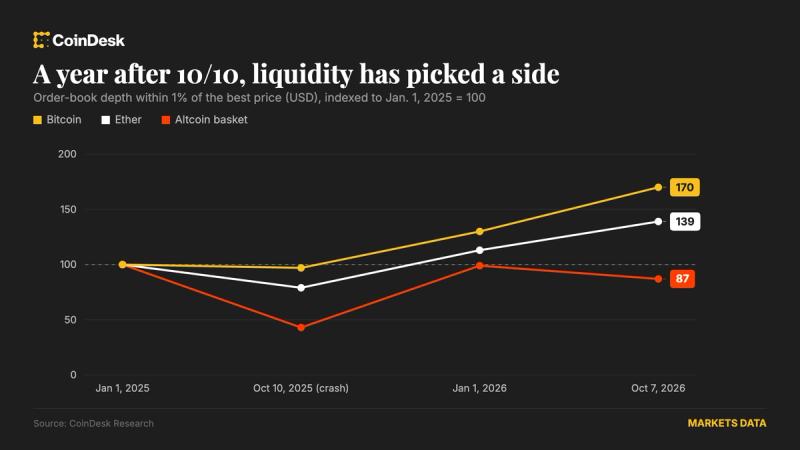
Bitcoin and ether order books are deeper than before the crash, while altcoin liquidity keeps eroding and spot trading remains well below its October 2025 peak.
One year after the largest liquidation event in crypto history, the market’s plumbing tells a split story. Bitcoin and ether order books hold more resting liquidity now than on the day of the crash or at the start of this year. Smaller tokens and spot trading, however, have not followed.
Days after hitting a record high above $126,000, bitcoin, on the morning of Oct. 10, 2025, had edged back to $122,600. Hours later, it had plunged below $105,000, with much of the decline coming in minutes in thin Friday evening (U.S. time) trade after President Donald Trump announced 100% tariffs on Chinese imports. More than $19 billion in leveraged positions were liquidated in a single day.
To gauge the recovery since, CoinDesk Research compared market depth across major centralized exchanges on four dates: Jan. 1, 2025; Oct. 10, 2025; Jan. 1, 2026; and this week. Depth is the value of buy and sell orders resting near the current price. The deeper the book, the more volume a large trade can absorb without moving the market.
Bitcoin’s order book is deeper now than on any of those earlier dates. On Oct. 7, about $11.7 million sat within 1% of the price. That is roughly 75% more than on crash day a year earlier, up from about $9 million at the start of this year and about $6.9 million at the start of 2025.
This isn’t a price effect. Bitcoin is about one-third cheaper than before the crash, so a deeper book, measured in dollars, reflects more capital committed by market makers, not just less valuable coins.
Most of the improvement is near the price, where market makers quote most actively. Further out, at 5% from the price, the depth of around $24 million is roughly where it was in January 2025.
Ether’s recovery is in some ways stronger. Depth within 0.5% of the price has more than doubled since crash day, to about $4.2 million. At 1%, it has risen by about three-quarters to roughly $5.3 million, above both January readings.
“The majors’ deepening is real capital, not a price effect,” CoinDesk Researcher Saksham Diwan said.
The rebuilt books got an early test this week. As the market sold off, bitcoin’s 1% depth fell about 12% between Oct. 7 and Oct. 8. Ether’s tightest band thinned slightly, though orders further from the price increased.
For altcoins, the picture is reversed. In CoinDesk Research’s basket of altcoins, dollar depth was greatest on Jan. 1, 2025, and has been lower on each date measured since.
Depth at 5% from the price is down about a third since the start of 2025, to around $2 million. Closer to the price, at 1%, it has fallen by about a sixth.
Measured in tokens, alt depth looks healthier: it peaked on Jan. 1 this year and has eased only modestly since. But analysts said that token-unit recovery was mostly due to falling prices, masking a steady erosion in committed capital.
Spot trading has not recovered. Weekly spot volume on centralized exchanges averaged around $279 billion over the four weeks to Sept. 27, according to CoinDesk Research, nearly two-thirds below the $801 billion traded in the week of the crash.
Activity bottomed out in August, when weekly volume fell to around $135 billion, and has doubled since. But it remains well short of levels seen around the crash.
Crypto’s liquidity vanished in hours on Oct. 10, 2025. Where it was next was the open question.
“A year ago, we wrote that liquidity was thin and fragmented, and that it was unclear where capital would rotate once the dust settled. We now have an answer: bitcoin and ether,” said Joshua de Vos, manager at CoinDesk Research. “Market makers have returned to majors, with liquidity above pre-crash levels, whilst altcoin liquidity continues to trend down as a whole. Beyond a select few alts, I expect this divergence to persist into next year as majors continue to dominate institutional interest and volumes.”
Diversified RWA stablecoins sustain 5-7% yield from real credit as crypto funding compresses to ~4%. GENIUS pushes yield off-chain; TAM grows to $4B in 3 years.
Asanat Analysis — Why it matters
The divergence between BTC/ETH liquidity recovery and altcoin deterioration suggests a structural flight-to-quality one year after the October 2025 crisis. Market participants have consolidated around the two largest assets, leaving smaller-cap tokens in a prolonged liquidity drought. This mirrors post-2018 consolidation patterns where infrastructure maturation favored blue chips while retail enthusiasm for speculative alts remained suppressed for years.
Spot trading volume remaining depressed—despite order book depth recovery in majors—indicates a cautious market structure. Lower volume alongside deeper books typically reflects institutional accumulation and algorithmic market-making rather than retail enthusiasm. For altcoin ecosystems, the persistent liquidity erosion creates cascading risks: reduced arbitrage activity, wider bid-ask spreads, and higher slippage for large trades, which can trigger cascade liquidations in leveraged positions across DeFi protocols dependent on those tokens as collateral.
The anniversary marker is significant for market psychology. If institutional confidence in altcoin infrastructure remains impaired this late into recovery, it signals either fundamental concerns about underlying protocols or a permanent reallocation of capital toward regulatory-safer assets. Projects with material DeFi dependencies should monitor collateral ratios closely as liquidation thresholds become more fragile in low-liquidity conditions.