Over 11 million bitcoin has no known owner. Here's what it means
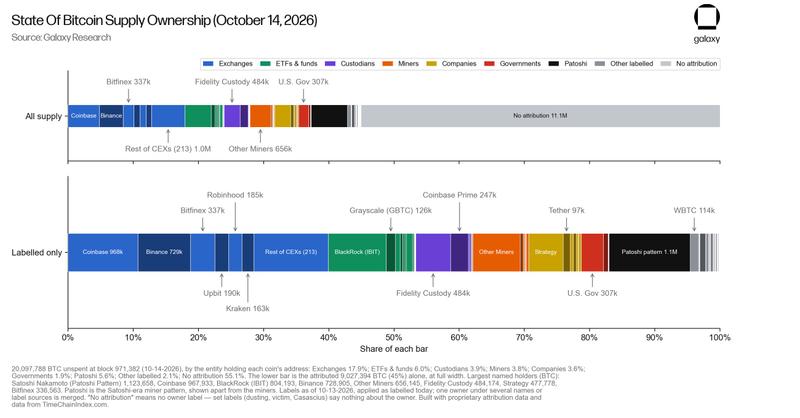
The large number of coins held in unidentified wallets shows that retail investors have been in this market for years, observers said. But this interpretation comes with a caveat.
Bitcoin BTC$84,459.46 is no longer a fringe asset but one with growing acceptance on Wall Street. Yet those tracking blockchain data still can't link most BTC to a known owner.
About 11.1 million BTC, roughly 55% of the supply, was classified as unattributed in Galaxy’s October snapshot. Those coins could belong to individuals, institutions the firm hasn’t identified or holders who can no longer access them.
Galaxy’s head of research, Alex Thorn, sees the figure as evidence that self-custody remains widespread, with people keeping control of their bitcoin keys despite the growth of exchanges, funds and institutional custodians.
"More than half of all BTC supply is sitting in addresses with no known attribution despite all the institutionalization and centralized ownership over the years, still a ton of bitcoin (maybe even most) is held by individuals in self-custody," Thorn wrote on X.
Self-custody means holding your own bitcoin keys rather than leaving coins with an exchange or a fund.
Xapo Bank, a bitcoin-focused bank, replied to Thorn's post, saying that large number of coins held in unnamed wallets is a sign that retail investors have been here for over a decade. Bitcoin is often seen as the first market that grew from the bottom up: Retail investors began trading, and institutions then embraced it.
"And why bitcoin is for the people and people 'can be their own bank' Retail have been here for over a decade. Everyone else still catching up," the bank wrote.
BTC is the native token of the Bitcoin blockchain, a public ledger that lets anyone, anywhere, send and receive money. Miners verify these transactions and add them to the ledger, earning newly issued BTC as a reward. The setup is often held up as an example a perfectly competitive market.
A bitcoin address is like a bank account number on bitcoin's public ledger. Anyone can see how many coins sit at an address, while hiding the identity of the owner. Research firms like Galaxy try to put names to addresses by tracking wallets known to belong to exchanges, funds and other big holders.
The entire unnamed 55% stack doesn't necessarily belong to individuals holding their own coins for the long term.
It could include coins that are likely lost, sitting in wallets whose owners have forgotten their keys or have passed away.
Some were mined in bitcoin's early years by miners other than the one behind the Patoshi pattern, a set of bitcoin's earliest mined blocks that researchers link to a single miner, bitcoin's anonymous creator, Satoshi Nakamoto.
Some could belong to institutions Galaxy hasn't identified, such as funds, companies and OTC desks, which are brokers that arrange large bitcoin trades privately, away from exchanges. Some coins could belong to custody setups that spread coins across many addresses, making them harder to trace.
The other 45% does have names attached, and some of them are big names, including exchanges, ETFs led by BlackRock, the U.S. government and the single biggest holder, "Satoshi Nakamoto (Patoshi Pattern)," at 1,123,658 BTC. Galaxy counts those coins separately, as "the Satoshi-era miner pattern."
Still, for all the ETF headlines, the largest slice of bitcoin is the one nobody can name.
Diversified RWA stablecoins sustain 5-7% yield from real credit as crypto funding compresses to ~4%. GENIUS pushes yield off-chain; TAM grows to $4B in 3 years.
Asanat Analysis — Why it matters
The 11M BTC figure (roughly 52% of total supply) primarily reflects three categories: early lost coins from 2009-2013 (Satoshi's ~1M BTC, defunct exchange wallets, discarded drives), long-term HODLer positions with dormant addresses, and wallets whose ownership is genuinely ambiguous due to privacy practices or inheritance uncertainty. This is not new data—on-chain analysis has tracked dormant coin cohorts for years—but the framing as 'no known owner' conflates technical unidentifiability with actual loss or abandonment.
The retail interpretation requires scrutiny. While some coins do represent retail accumulation (particularly post-2015), attributing 11M BTC to retail assumes ownership patterns invisible on-chain. Institutional entities, early miners, and long-term entities deliberately use wallet rotation and privacy layers. The metric conflates 'unmonitored' with 'retail-held,' which overstates retail concentration. More granular analysis (age cohorts, cluster patterns, transfer velocity) would better segment lost vs. genuinely dormant vs. strategically held coins.
Macro implication: If even 3-4M BTC is permanently inaccessible (conservative estimates), effective supply is tighter than 21M suggests—a deflationary pressure rarely quantified in spot/futures pricing models. Conversely, if major wallets suddenly mobilize, liquidity assumptions reset. The 'unknown owner' framing masks the real question: what fraction is actually lost versus strategically immobilized?