Ten Decrees: Old Masters, New Money
Bitcoin Magazine Ten Decrees: Old Masters, New Money Lucho Poletti on redrawing Hieronymus Bosch and Pieter Bruegel the Elder around money, Nixon’s 1971 decree, and why bitcoin art keeps returning to...
Lucho Poletti on redrawing Hieronymus Bosch and Pieter Bruegel the Elder around money, Nixon’s 1971 decree, and why bitcoin art keeps returning to the old masters.
On August 15, 1971, Richard Nixon announced that he had directed Treasury Secretary John Connally “to suspend temporarily the convertibility of the dollar into gold.” The suspension was never lifted. Fifty-five years later to the day, Lucho Poletti unveiled the first of ten drawings responding to that decree.
Europe had experienced its own monetary upheavals. Hieronymus Bosch and Pieter Bruegel the Elder worked during an era of expanding banking, credit, and speculation. Antwerp, where Bruegel worked, became one of Europe’s great commercial centers. Both painters populated their compositions with hundreds of figures, constructing elaborate worlds in which human behavior, social order, and moral judgment could be examined simultaneously.
Bitcoin artists have increasingly returned to this visual tradition. Pepenardo’s Master Cuts Out the Stone, exhibited by BMAG earlier this year, reimagined Jan Sanders van Hemessen’s The Surgeon as a study of who extracts and who is extracted from. Carlijn Kingma’s The Waterworks of Money, shown at Bitcoin Amsterdam last year, depicted the modern monetary system as an interconnected landscape. Complex systems seem to invite pictures that hold everything in a single frame.
Lucho Poletti has made bitcoin-related art since 2017, describing his practice as visual propaganda for the monetary revolution. A contributor to the Bitcoin Conference art gallery since 2021, he returns to Bitcoin Amsterdam this November with Ten Decrees.
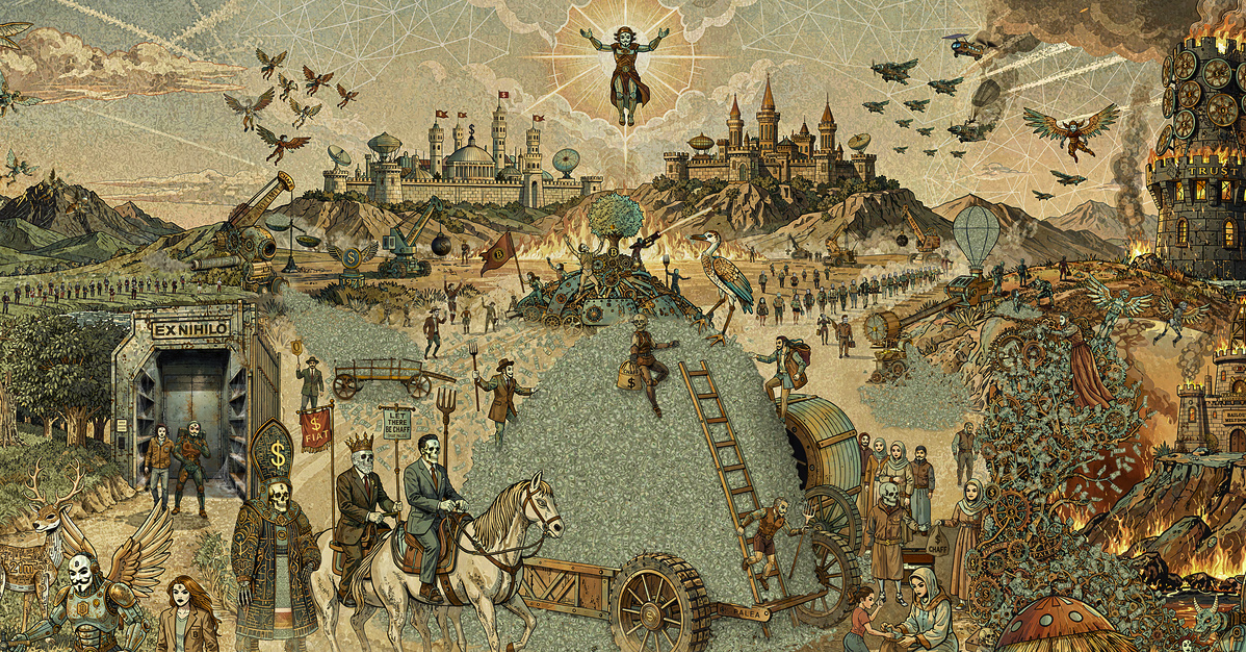
The series reimagines ten paintings, four by Bosch and six by Bruegel, around money. Fiat, Latin for “let it be done,” becomes the organizing principle. Nine titles issue commands: let there be fury, profit, chaff, a game, folly, hunger, refuge, collapse, and ash. The tenth, Ultima Fiat, reverses that authority: let it be the last.
Unveiled on August 15, 2026, the anniversary of Nixon’s announcement, the series follows a biweekly release schedule beginning August 29 and concluding January 3, 2027, the anniversary of Bitcoin’s Genesis Block. Each drawing contains hundreds of figures and objects, with inscriptions often visible only at close range. The 30-by-20-inch prints, produced in editions of ten, form a composition spanning approximately four meters when arranged in two rows of five.
Five drawings have been released, most recently Fiat Moria, after Bruegel’s Netherlandish Proverbs, on October 24. The sixth, Fiat Fames, follows November 7.
Ahead of Bitcoin Amsterdam, November 5–6, I spoke with Poletti about the recurring influence of Bosch and Bruegel on bitcoin art, the relationship between allegory and propaganda, and translating his densely detailed drawings to the conference’s main-stage LED installation.
BMAG: Bosch and Bruegel seem to be having a synchronistic moment among artists interested in Bitcoin. Both worked in what is now Belgium and the Netherlands, during a period when Antwerp was emerging as a major financial center and the Habsburgs were debasing coinage. What is it about transitional periods (like the current one) that draws artists back to Bosch and Bruegel and their densely populated landscapes?
Lucho Poletti: Because they had already solved the problem I was stuck with: how do you draw a whole society going wrong at once? Bosch and Bruegel put hundreds of people in a single frame, each busy with their own concerns. The system shows up in the sum of it. You don’t look at a Bruegel, you search it. It’s a great way to depict the effects of money, which nobody really sees and everybody feels.
They also lived through a money problem a lot like ours. Silver from the Americas poured into Europe through Seville and on to the bankers in Antwerp. Prices across Western Europe rose sixfold over 150 years. Philip II defaulted in 1557 and the crash spread across all of Europe. Two years later Bruegel painted Netherlandish Proverbs, a village where everyone is absorbed in something foolish and nobody can see the whole.
The four Bosch pieces are about appetite: the temptation, and the bill that shows up after. The six Bruegels are about the crowd, and how society behaves once the rules stop making sense.
BMAG: The series draws on the original meaning of the F-word every bitcoiner knows. Nine of your titles use fiat as a command, while the tenth, Ultima Fiat, seems to reverse that authority. How did you arrive at Latin as the language of the series, and why does the final decree change speaker?
Lucho Poletti: Fiat was never a noun. In Latin it’s a verb, “let it be done.” It’s the word God speaks in the Latin Genesis before the light comes on: fiat lux. Someone with authority says so and it happens. That’s a literal description of how fiat money comes into existence, so I wanted the verb in every title.
Latin wasn’t a stretch for me. I’ve titled work in it for years: Moneta Divina, Cypher Deos, and Novus Moneta Seclorum dating back to 2020. The dollar already speaks it, too. Turn over a one-dollar bill and there are three Latin mottos on the back. Ultima Fiat, Fiat Lucrum and Furia Fiat had their names before the series did. Once there were three decrees in concept, I kept going until I had ten, and the name for the whole series became obvious. Ten Decrees has the Ten Commandments sitting under it, which suits work rebuilt out of painted sermons. In Fiat Lucrum there’s a lighthouse at the top left with FIAT LUX GENESIS 1:3 engraved into it. The title is the phrase rewritten for the money printers: let there be light turned into let there be profit.
Nine of the decrees are issued to you, in the flat voice an institution uses. Let there be profit, let there be hunger, let there be a game. The tenth is the only one we get to say back. Ultima fiat means “let it be the last,” which is closer to a plea than an order. Every one of us has been living under the first nine since 1971, whether we noticed or not, and Bitcoin is how we issue the tenth. It closes the series on January 3, the anniversary of the Genesis Block, which also happens to be my birthday.
BMAG: Bosch and Bruegel constructed extraordinarily complex visual worlds where allegory, satire, religious symbolism, and everyday life coexist. Their paintings invite close inspection but rarely offer a single, definitive interpretation. In Ten Decrees, you’re borrowing their compositions while introducing a more explicit critique of the monetary system. How do you approach the relationship between ambiguity and message in your work?
Lucho Poletti: The words carry the message so the people don’t have to. Bosch’s Garden of Earthly Delights doesn’t have a single word in it. Fiat Lucrum has more than fifty lettered objects, and some are as blunt as a protest sign: four money presses lettered QE-1, QE-2, QE-3 and QE-∞, and a little hand-lettered card on a broker’s desk that reads genius, we print, you pay, have a nice day. Nobody has to wonder what I think of the money system.
I keep the ambiguity in the people. In Fiat Lucrum there’s a crowd cheering a woman who holds up a $ on a golden staff under a sign that says ETF, and that crowd is wearing my mask. So is the man signing the leverage contract, and so is the woman taking the mortgage. In Fiat Palea a man in the mask is knee-deep in a pile of printed bills. Bosch drew his own neighbors into the middle of the garden, and I drew mine. If the ₿ on a forehead were a badge of honor, I wouldn’t hand it out like that. It’s more a badge of the aware, the initiated. Knowing the money is broken doesn’t make one a saint.
I’m careful with endings too. These pieces show the exit while not promising a way out. Near the middle of Fiat Moria there’s a lit doorway with MONEY ₿ BETTER WORLD over the arch, and a plain-faced man on the step looking back at the square. He hasn’t gone in yet, and nobody’s stopping him. Where you’d be standing in that picture is your call.
BMAG: In Fiat Lucrum, your reinterpretation of Bosch’s Garden of Earthly Delights, you introduce a system of waterworks: pipes, reservoirs, and flowing liquidity. Bosch often allowed viewers to recognize things that the figures within his paintings could not. What possibilities does that kind of visual allegory offer you when depicting something as abstract as the monetary system?
Lucho Poletti: What Bosch never had in his garden was plumbing, so I gave it some. Water organizes the whole of Fiat Lucrum. It starts clean high in the mountains on the left, pours out of a machine in Eden and settles in a reflecting basin. Cut into the basin’s wall there’s an inspection window with fish swimming behind the glass. Somebody built a viewing port into the reservoir so you could check it, and every full node on the Bitcoin network is that window.
Downstream the water widens into a lake. In the middle sits a glass tank lettered FRESH LIQUIDITY, with BOTTOMLESS engraved on the bowl, and eight people are having the party of their lives inside it. The valve wheel that controls the flow is on top of the dome, outside the glass, where none of them can reach it. Monetary policy gets set by someone who isn’t at the party. And the tank leaks. From there the water runs orange, down a stream and over a waterfall into a pool where a tick with a $ on its cheek drinks it through a hose.
Asanat Analysis — Why it matters
This piece uses historical art—specifically Bosch and Bruegel—as a lens to examine how humans visualize economic systems and their breaking points. The reference to Nixon's 1971 decree (closing the gold window) signals a thematic throughline: pivotal monetary inflection points have always generated cultural artifacts that process what's being lost or gained. Bitcoin's emergence as a cultural object follows this pattern, recontextualizing Old Masters imagery to interrogate what 'value' means when its substrate shifts from state-backed fiat to decentralized consensus.
The framing matters because it positions bitcoin not as a pure technology narrative but as a monetary philosophy with deep cultural roots. Art-historical parallels suggest this cycle—crisis, revaluation, artistic reinterpretation—is endemic to money systems undergoing legitimacy transitions. Bosch's and Bruegel's work documented societal upheaval; their contemporary redeployment in crypto contexts indicates how digital asset communities are self-consciously narrating their own institutional challenge to state monetary monopolies, whether or not that challenge succeeds.
For market participants, this signals sustained cultural legitimization efforts within crypto communities rather than purely technical or financial developments. When a major publication like Bitcoin Magazine frames the space through art history rather than price action or protocol upgrades, it reflects how the sector increasingly competes on narrative coherence and historical inevitability—a maturation signal that precedes or accompanies institutional adoption cycles.