Treasury's Bessent sees crypto as America's next tool for keeping the U.S. dollar on top
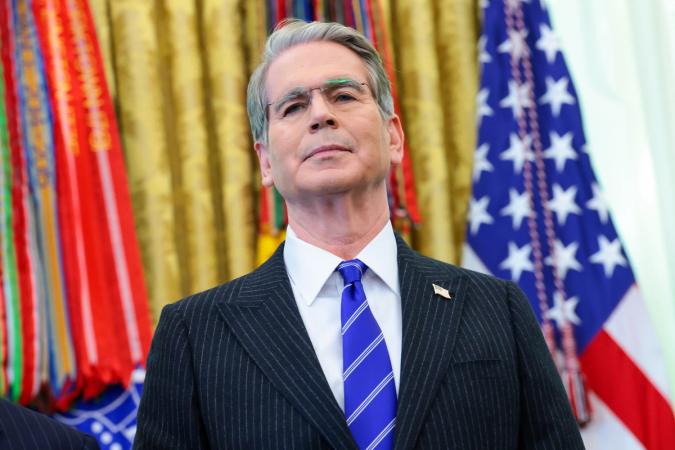
Speaking at Ripple's conference, the U.S. Treasury Secretary said the SEC and CFTC action could help fill the gap left by the Clarity Act's failure, while curbing crypto debanking.
U.S. Treasury Secretary Scott Bessent said digital assets could help strengthen the U.S. dollar's global dominance as technology becomes an increasingly important source of American economic influence.
Speaking Tuesday at Ripple's Swell conference with CEO Brad Garlinghouse, Bessent argued that the power behind the world's reserve currencies during history derived from military strength, but it’s increasingly shifting toward technological leadership.
"We will keep our military umbrella, but I think more and more it's becoming a technology umbrella," Bessent said.
He pointed to the growing divide between U.S. and Chinese technology ecosystems, where countries and companies face choices over whose artificial intelligence systems and semiconductor technology to adopt. Bessent said he sees digital assets as part of that competition, with the financial infrastructure countries may choose influencing the U.S. dollar’s reach.
"I think that digital assets are going to be no different, and we are going to win in the digital asset stack, and that's gonna continue to fortify the [U.S.] dollar," he said.
His remarks offered a broader rationale for the administration of President Donald Trump’s push to bring crypto businesses onshore, framing digital assets not just as a financial market but as part of the infrastructure that could sustain U.S. economic influence. The administration has already secured passage of the GENIUS Act, which established a federal regulatory framework for stablecoins, cryptocurrencies designed to maintain a fixed value against fiat currencies like the U.S. dollar.
Bessent argued that stablecoins could reinforce the dollar's position by expanding access to U.S. currency in countries where local currencies face inflation or sharp swings in value.
More than 90% of stablecoins are backed by U.S. dollars, he said, and their issuers often hold U.S. government securities as reserves. As adoption grows, demand for those assets could rise, creating another source of financing for the federal government.
"I think it's gonna be an important source of funding for the Treasury," Bessent said.
Bessent pushed back against the idea that stablecoins would merely replace dollars people already hold, arguing that they could reach new users in emerging markets who want to protect their savings from currency devaluation.
However, the White House’s broader push to regulate crypto markets suffered a setback after Congress failed to pass the Clarity Act, which would have established a federal framework for the industry.
Bessent called the failure a disappointment but said the Treasury Department could work with regulatory agencies like the Securities and Exchange Commission (SEC) and Commodity Futures Trading Commission (CFTC) to advance oversight through agency action.
"At Treasury, we have a lot of convening powers," he said, describing the SEC and CFTC as “great partners” in forming a regulatory framework that could serve as a model for other countries.
The agencies' regulatory efforts could provide more clarity for crypto firms, though rules adopted by regulators would lack the permanence of legislation.
Bessent also addressed the industry's concerns about debanking, a term used to describe financial institutions cutting off services to crypto businesses, sometimes allegedly under regulatory pressure.
He said the Clarity Act would have helped prevent a return to such practices but argued that regulatory safeguards could still offer protection.
"I think we can set up regulatory best practices, guardrails that will prevent that from happening again," Bessent said.
Diversified RWA stablecoins sustain 5-7% yield from real credit as crypto funding compresses to ~4%. GENIUS pushes yield off-chain; TAM grows to $4B in 3 years.
Asanat Analysis — Why it matters
Bessent's framing of crypto as a dollar-dominance tool represents a significant rhetorical shift from prior Treasury skepticism. By positioning regulatory clarity and stablecoin infrastructure as extensions of U.S. monetary policy rather than threats to it, he's signaling alignment with the private sector's decade-long push for functional frameworks. The reference to the Clarity Act's failure—legislation that would have created explicit stablecoin authority—suggests Treasury is pivoting toward SEC/CFTC enforcement as a makeshift solution, deputizing existing agencies rather than pursuing new legislative mandates.
The debanking angle is particularly notable. Crypto companies have faced persistent financial exclusion despite regulatory compliance; Bessent's acknowledgment suggests Treasury recognizes this as a competitive liability if other nations establish parallel payment rails. This echoes arguments from Ripple and other infrastructure players that dollar hegemony depends on accessibility, not just legal restrictions. However, regulatory action via existing agencies lacks the statutory clarity markets typically demand for sustained adoption, creating execution risk around what 'action' actually entails.
For the sector, this represents tactical validation but not structural resolution. SEC/CFTC coordination could clarify spot asset treatment and custody standards, but without Congressional backing, Treasury's ability to address debanking remains limited—banking compliance decisions ultimately rest with individual institutions, not regulators.