U.S. agency hits Utah with lawsuit to shield Kalshi's ability to offer betting there
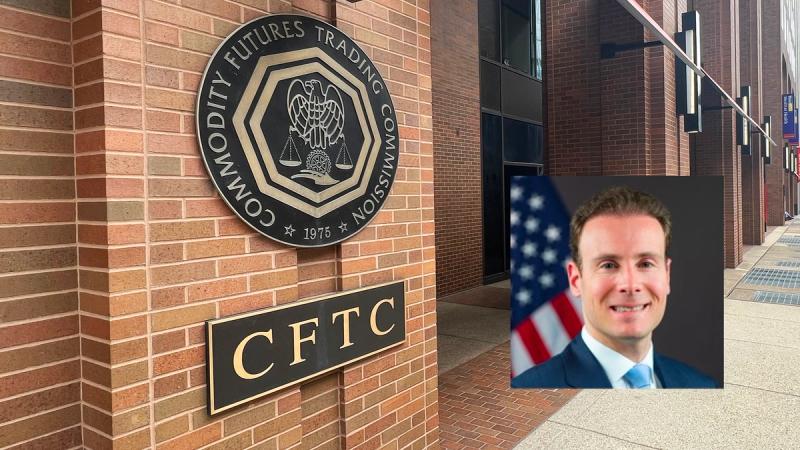
The U.S. Commodity Futures Trading Commission has pursued more than a dozen legal actions to protect what its chief sees as its sole power over prediction markets.
The U.S. agency that oversees derivatives has filed a federal legal challenge to halt Utah's attempt to stop prediction market betting in its state, where gambling is constitutionally banned.
The U.S. Commodity Futures Trading Commission is asking the court to put a stop to the Utah attorney general's enforcement effort last week that was meant to restrict Kalshi from offering gambling to residents in the state, where it's illegal. After Utah has so far prevailed against Kalshi in federal court, the federal agency is weighing in with its own lawsuit, the CFTC said on Tuesday.
"Event contracts do not just serve hedging and investment purposes — they also provide the public with information about the outcome of future events," said CFTC Chairman Mike Selig in a statement, which also further defended what he sees as his agency's legal role as the sole regulator of prediction markets.
The matter of the dispute between states' legal rights and federal preemption (with Kalshi and other prediction market firms firmly on the latter side) has grown increasingly complicated due to conflicting rulings from various courts. Three federal appellate courts have issued two decisions that sided with the states and one that went Kalshi's way. In Utah, a U.S. district court judge sided with the state in a case that's also under appeal.
"Anyone offering gambling to Utahns is on notice that it is illegal in Utah and that no Utah law authorizes it," Attorney General Derek Brown said in a statement last week, accusing Kalshi of running an online casino.
The CFTC is currently battling 10 states in court and has been filing legal arguments across the full spectrum of the judicial system — all while having been cut in legal staffing as the administration of President Donald Trump has sought to reduce U.S. regulatory forces.
While Selig's view is uncompromising about the CFTC's proper role, another former agency chairman, Democrat Gary Gensler, filed a brief with the U.S. Supreme Court to argue that Selig's read is wrong and that the law Gensler helped usher in wasn't meant to be interpreted this way. Gensler — better known in crypto circles as the recent ex-chair of the Securities and Exchange Commission — told the high court that the Dodd-Frank Act the agency uses as its legal justification "did not transfer jurisdiction over sports betting from the states to the CFTC."
One of the authors of the Dodd-Frank Act, former Senator Chris Dodd, similarly filed an amicus brief agreeing with the state view.
Diversified RWA stablecoins sustain 5-7% yield from real credit as crypto funding compresses to ~4%. GENIUS pushes yield off-chain; TAM grows to $4B in 3 years.
Asanat Analysis — Why it matters
The CFTC's litigation strategy reflects an escalating turf war over prediction market jurisdiction. By suing to protect Kalshi's operations in Utah, the agency is asserting that binary options and event derivatives fall exclusively under federal commodity regulation, not state gambling laws. This represents a shift from passive oversight to active legal defense of market participants—unusual positioning that signals the CFTC views prediction markets as strategically important infrastructure worth fighting for.
Kalshi's Utah case sits within a broader pattern: the CFTC has filed 12+ similar actions, suggesting systematic resistance from state regulators and incumbent interests threatened by crypto-native derivatives. The outcome will likely determine whether prediction markets can scale nationally or remain bottlenecked by state-by-state compliance friction. This matters because prediction markets are early-stage but structurally significant—they aggregate dispersed information and could reshape how institutions price tail risks and political outcomes. A CFTC victory establishes clearer federal preemption; a loss fragmentizes the market and potentially invites state-level bans.
The timing is notable: as on-chain derivatives mature and traditional finance explores event-based contracts, regulatory clarity becomes prerequisite infrastructure. Whether Kalshi prevails shapes not just its own business but the competitive moat for other CFTC-regulated platforms versus unregulated offshore alternatives.