Bitcoin drops below $80,000 as crypto ignores Asian tech rally, Fed meeting begins
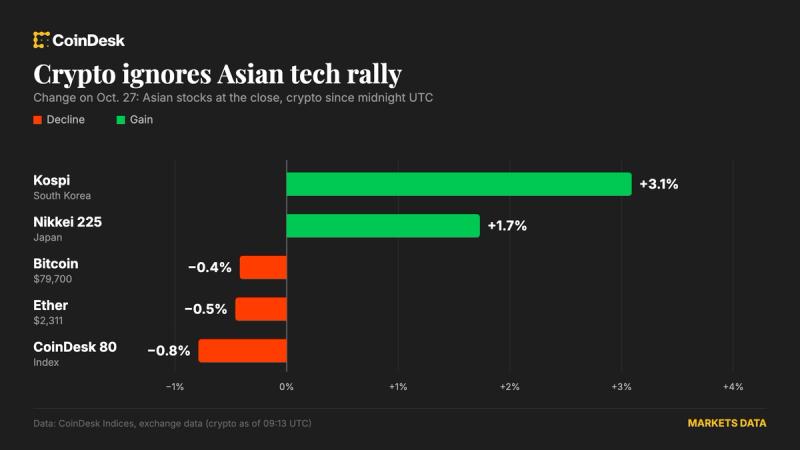
Bitcoin fell 0.4% to around $79,700 since midnight UTC while Asian tech stocks rallied. The DeFi index dropped 1.8%, and the Fed is set to begin a two-day meeting.
Bitcoin BTC$84,459.46 slipped below $80,000 on Tuesday, dropping 0.4% since midnight UTC to near $79,700. Altcoins fell further, with ether ETH$2,490.55, the largest, losing 0.5%. The DeFi index (DFX) dropped 1.8%, the most of any CoinDesk index, a reversal from Monday, when it was the only index to gain.
U.S. stock index futures edged lower ahead of big-tech earnings later this week. Asian tech shares rallied, with South Korea’s Kospi rising 3.1%, though the advance didn’t pull crypto along with it. Oil rose, with U.S. crude approaching $102 a barrel.
The Federal Reserve begins a two-day meeting today, with an interest-rate decision on Wednesday and CME’s FedWatch tool showing around a 90% chance of no change. Traders will be looking for clues on whether another rate increase is likely before year-end. U.S. spot bitcoin ETFs took in $110 million on Monday, according to Farside Investors, ending two days of outflows.
Diversified RWA stablecoins sustain 5-7% yield from real credit as crypto funding compresses to ~4%. GENIUS pushes yield off-chain; TAM grows to $4B in 3 years.
Asanat Analysis — Why it matters
Bitcoin's sub-$80k move amid broad Asian tech strength signals a decoupling between crypto risk appetite and traditional equity momentum. This breakdown matters because historically, crypto has tracked risk-on sentiment across markets; divergence suggests either crypto-specific headwinds or a reallocation event. The DeFi index's steeper 1.8% drop indicates that leveraged and yield-dependent protocols are absorbing more selling pressure, consistent with pre-meeting de-risking as traders prepare for Fed forward guidance that could reset rate expectations.
The timing around a Fed decision is structural, not accidental. Markets typically reprice volatility ahead of central bank meetings, and crypto's sensitivity to rate expectations remains elevated given the sector's dependence on liquidity conditions and risk capital allocation. A stronger dollar or hawkish signaling could extend selling; dovish messaging might stabilize valuations. The Asian tech resilience without crypto participation suggests regional or sector-specific flows, not a fundamental repricing of growth outlook—keeping the outcome of the Fed's two-day deliberation as the primary driver for broader directional bias.