Bitcoin slips below $83,000 as Ethereum researcher's 'bunker mode' call divides crypto
Justin Drake's call to prepare for an AI break of wallet cryptography drew a mixed response as bitcoin slipped below $83,000.
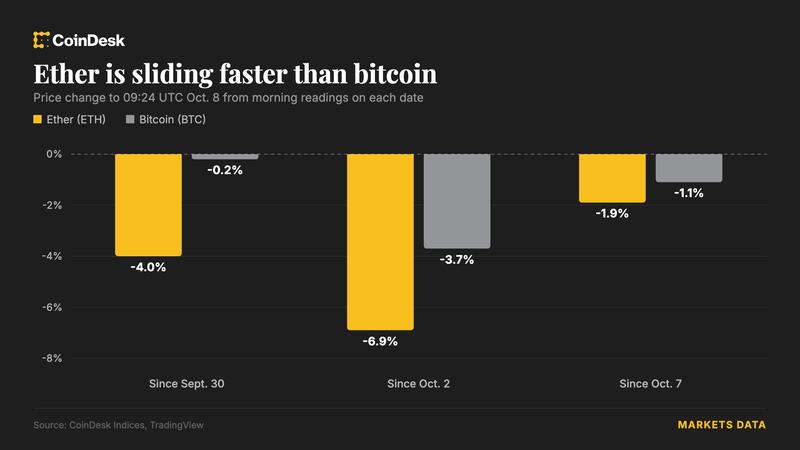
Bitcoin BTC$82,659.99 extended its slide during Asian hours, dipping to about $82,300 before recovering to around $82,800, roughly 4% below Tuesday's high near $86,600. The CoinDesk 100 has lost close to 2% over 24 hours.
Ethereum Foundation researcher Justin Drake used a post on X, viewed almost 4 million times, to urge the industry to begin planning for what he called "bunker mode."
The idea is a gradual migration of funds to new addresses whose public keys have never been exposed. Drake argued that AI-driven advances in mathematics make it reasonable to brace for a break of the elliptic-curve signatures securing bitcoin and ether wallets in "months not years." He pointed to a batch of 722 mathematical results released by OpenAI this week as evidence.
Not everyone agreed on the urgency. Ethereum co-founder Vitalik Buterin said the risk from AI-accelerated math should be taken seriously, but advised holders against scrambling to move funds. Samson Mow, CEO of bitcoin technology firm Jan3, told followers there was no need to panic "because an Ethereum researcher is saying silly things."
The pressure from bond markets has also not let up, with the 30-year Treasury yield climbing 4 basis points to 5.71% and the 10-year to 5.32%, according to CNBC, ahead of a $22 billion 30-year bond auction later Thursday.
Minutes of the Fed's September meeting, released Wednesday, showed all 19 officials backed last month's interest-rate increase, with most seeing another as likely appropriate by year-end. September's consumer price index on Oct. 14 is the last inflation reading before the Fed's Oct. 28 decision.
As stablecoins move into regulated finance, APAC is becoming a key proving ground. This report maps the region’s rules, use cases, and RLUSD’s role.
Asanat Analysis — Why it matters
Justin Drake's 'bunker mode' proposal—preparing for potential cryptographic breaks via quantum computing or AI advancement—surfaced amid Bitcoin's dip below $83k, triggering renewed debate about cryptography's long-term viability in crypto systems. The Ethereum researcher's framing conflates two distinct threat vectors: quantum computing (a known, decades-away risk with existing mitigation pathways like lattice-based cryptography) and AI-driven cryptanalysis (speculative, absent technical consensus). This distinction matters: one is an engineering problem with known solutions; the other invokes AI capabilities not yet demonstrated against modern cryptographic primitives.
The proposal's divisive reception reflects a fundamental tension in crypto security culture. Maximalists interpret it as FUD undermining confidence in Bitcoin's immutability narrative; pragmatists see it as prudent long-term risk management. Historically, crypto has responded poorly to existential uncertainty (see: 2017 scaling debates, 2021 environmental scrutiny). A sustained 'cryptographic vulnerability' narrative—even speculative—could erode institutional confidence and pressure exchanges toward regulatory custody of user keys, ironically centralizing the very systems crypto decentralization was meant to prevent.
The timing (market weakness + researcher credibility + vague threat definition) suggests this shapes regulatory discourse more than immediate technical risk. Governments exploring post-quantum cryptography standards may cite Drake's remarks to justify surveillance frameworks or mandatory key escrow. Market reaction—below-$83k Bitcoin—appears reactive to sentiment rather than fundamental, but signals how narrative vulnerability (not cryptographic vulnerability) remains crypto's persistent systemic risk.