Bitcoin ETFs shed $450 million as Clarity Act fails
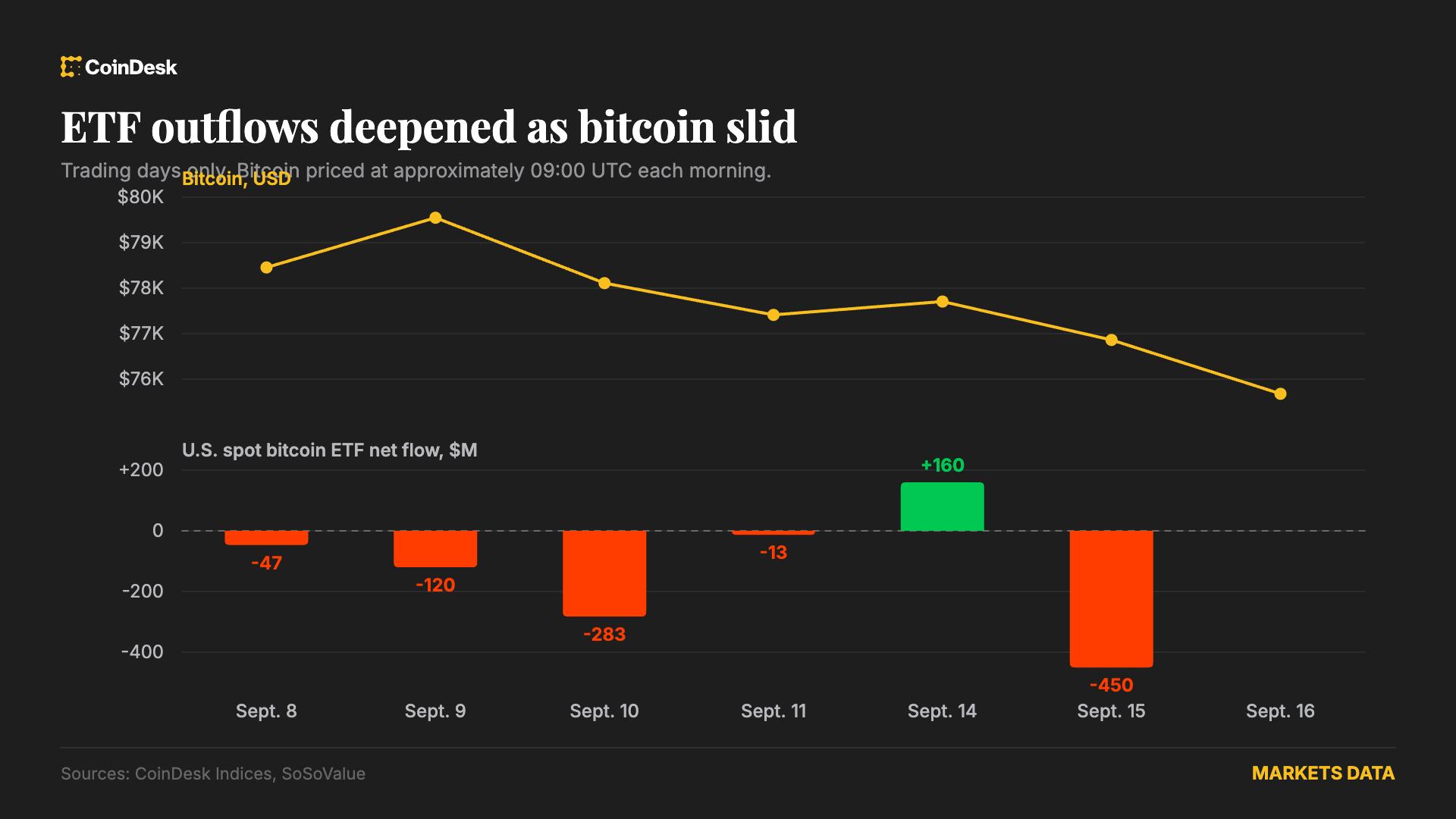
U.S. spot bitcoin ETFs shed $450 million, the most since June, as the Senate's failure to advance the Clarity Act sent regulatory-sensitive tokens sharply lower.
U.S. spot bitcoin BTC$75,881.02 ETFs shed $450 million on Tuesday, according to SoSoValue, the heaviest single-day outflow since June 25, after the U.S. Senate declined to advance the Digital Asset Market Clarity Act.
Bitcoin BTC$75,881.02 is little changed since midnight UTC, after dropping following the vote, which garnered around 10 fewer votes than the 60 required. Among those opposing the motion were seven Democrats who had spent months negotiating the text.
The CoinDesk 20 Index also held its loss, dropping less than 0.1% since midnight after falling 4.6% on Tuesday in the steepest decline since June 5.
Attention now switches to the Federal Reserve, which announces its interest-rate decision later today, with an increase having been the market's base case going into the meeting.
The bill’s failure effectively ends any prospect of market structure legislation clearing the Senate this year, with Congress expected to be under split control in January.
Bitcoin’s 24-hour drop of 1.7% seems muted compared with slides in the tokens most exposed to U.S. regulatory treatment.
Stellar XLM$0.1754 fell 9.6% over 24 hours and XRP lost 8.1% Among CoinDesk 100 constituents, a full 95 lost value over the period.
Traditional markets have been steady by comparison, with Nasdaq 100 index futures adding 0.33%, gold 0.88% higher and silver rising 1.37%, while the Dollar Index is unchanged.
As stablecoins move into regulated finance, APAC is becoming a key proving ground. This report maps the region’s rules, use cases, and RLUSD’s role.
Asanat Analysis — Why it matters
The Clarity Act's failure signals a structural shift in regulatory expectations for crypto markets. With seven Democrats withdrawing support after months of negotiation, the bill's collapse reveals deep partisan fractures on digital asset classification—a foundation issue that affects everything from tax treatment to custody rules. The absence of market structure legislation through 2026 and into a divided Congress means regulatory clarity will likely come through enforcement (SEC/CFTC actions) rather than legislation, creating persistent uncertainty for institutional adoption.
The selective selloff pattern is instructive: XRP and Stellar dropped 8-10% while Bitcoin fell only 1.7%, indicating that altcoins with higher regulatory sensitivity (Stellar's CBDC use case, XRP's historical SEC lawsuit legacy) face disproportionate risk repricing. The $450M ETF outflow—largest since June—suggests some institutional retreat, though this pales against Bitcoin's $1T+ market cap. The privacy trade (ZEC +6.9%) offsetting broader losses hints at investor rotation toward less-scrutinized narratives rather than genuine capitulation.
The immediate catalyst (Fed rate decision later that day) may have amplified the move, but the underlying driver is regulatory optionality collapse. Markets had priced in possible legislative guardrails; their removal eliminates a de-risking narrative that supported altcoin valuations. This doesn't signal a crypto market crisis—Bitcoin's resilience and institutional ETF flows remain constructive—but it does reset expectations for which assets benefit from U.S. regulatory clarity versus which face ongoing jurisdictional ambiguity.