The data proves it: Bitcoin doesn't care about rising bond yields over long-term
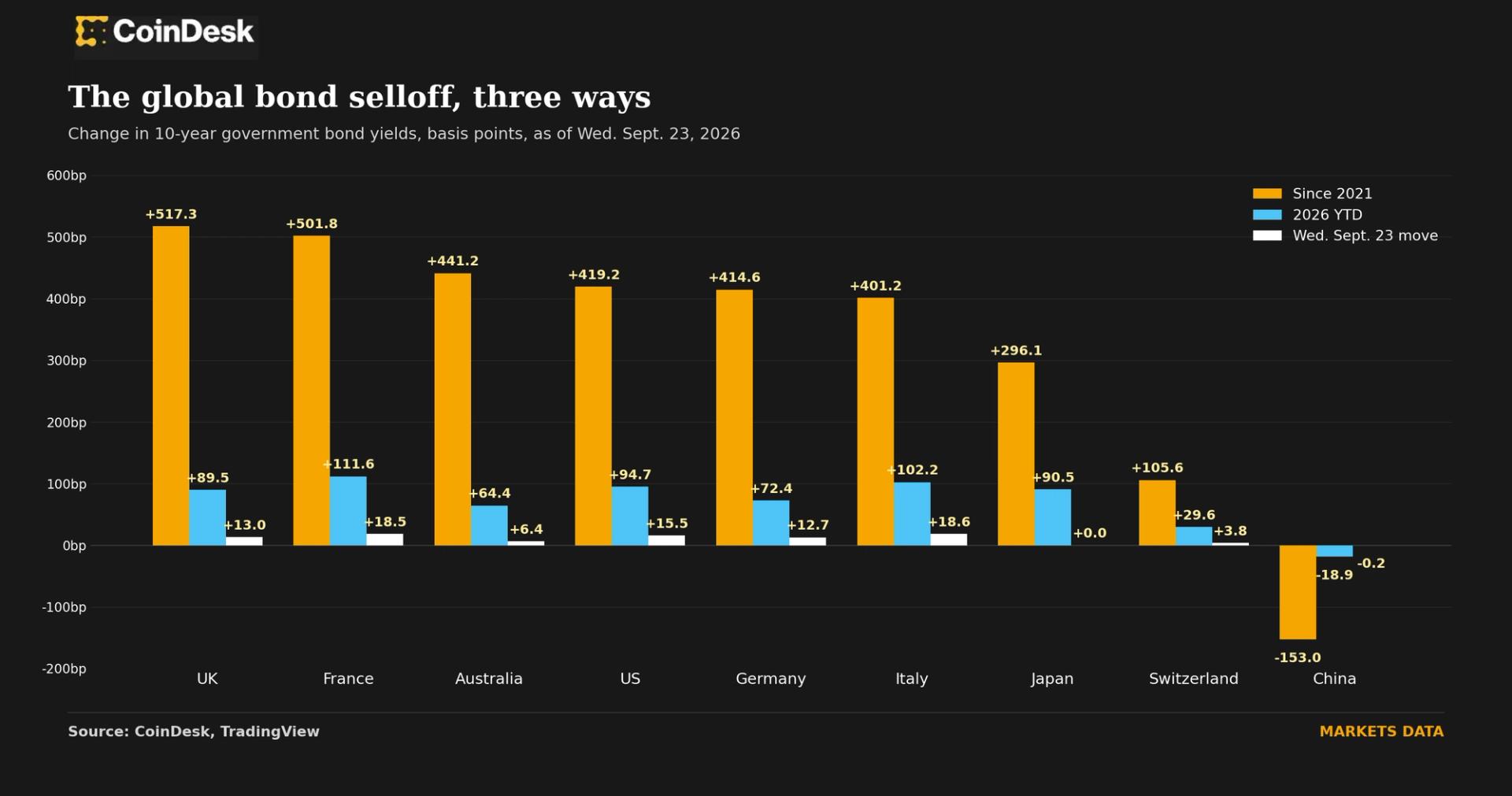
Long-term, BTC ignores rising bond yields. In the short term, however, surging bond volatility could easily dampen crypto's animal spirits.
As global bond yields rise, the usual narrative frames it as bearish for bitcoin BTC$83,219.41. Yet over most of BTC’s history, the asset has shown little to no consistent correlation with bonds.
Yields snapped back into focus Wednesday. The U.S. 10-year jumped 15 basis points to its highest level since 2007, topping 5.13%, and pulled yields higher across the globe, as the feature image shows.
The standard interpretation is that as yields climb, the opportunity cost of holding non-yielding assets like bitcoin and gold rises, potentially pulling money toward bonds instead. In short, it’s a headwind, not a tailwind, for crypto.
The 90-day correlation between bitcoin's daily returns and the U.S. 10-year yield's daily moves is just −0.18, according to data analyzed by CoinDesk. That's close to zero and almost indistinguishable from no relationship at all.
Longer windows show the same thing, with the 180-day correlation at −0.06 and the 1-year figure at −0.03. Bitcoin is equally uncorrelated to yields of other nations.
Being this uncorrelated is actually a benefit. It means bitcoin can serve a similar role to other alternative investments in improving a portfolio's risk-adjusted returns, as investment banks have argued for years. Crypto analysts suggest the same.
“Bitcoin’s near-zero correlation with U.S. Treasury yields is a genuine portfolio advantage because it suggests BTC is not simply trading as a duration or rates asset. Recent data shows the 90-day correlation between Bitcoin’s daily returns and the U.S. 10-year yield at around -0.17, with the relationship at times moving even closer to zero,” Lacie Zhang, research lead at Bitget Wallet, told CoinDesk.
Bitcoin's broader performance backs this up too. It's up 191% since 2021, and hit a record price of $126,000 last October. That happened even as 10-year yields climbed more than 500 basis points in the U.K. and France, and over 400 in the U.S., Australia, Germany, and Italy over the same stretch.
Japanese and Swiss yields have risen by 296 and 105 basis points, respectively, while China’s have dropped as the country has been battling deflation.
Being broadly uncorrelated doesn’t necessarily insulate bitcoin from short-term pain, especially when the pain comes from the bond market volatility itself rather than the level of yields.
A sudden spike in bond market turbulence, particularly in Treasuries, which underpin global finance, can tighten financial conditions, make credit more expensive, and trigger broader risk aversion.
The MOVE Index, which tracks expected turbulence in Treasury notes, surged 21% to 95 points on Wednesday, its highest level since April 1. That helps explain bitcoin's pullback from $87,200 to $83,500 on Wednesday, though the market may also have simply been looking for a reason to pull back after the recent steep run higher.
S&P Global's flash U.S. Composite PMI rose to 58.4 in September, the highest reading since July 2021, up from 56.0 in August, with business activity expanding at its fastest pace in more than five years alongside a buildup in inflationary pressure.
That data reinforced expectations that the Fed will need to keep hiking after the September rate increase of 25 basis points. The 10-year and two-year yields both jumped on it.
But a closer look at the feature image shows France's yield actually rose more than the U.S.'s on Wednesday, even though it was U.S. data driving the move. The U.K.'s yield also rose nearly as much as the U.S. Per Robin Brooks, Senior Fellow at the Brookings Institution and former chief economist at the IIF, the same held for Italy and Greece.
"What happened today is that we got strong data for the U.S. and then fiscally vulnerable places caught on fire," Brooks wrote in a Substack post published Wednesday.
This isn't new, according to Brooks. Markets have been penalizing high fiscal debt countries for a while now.
Japan was in the pole position at the end of 2025 with the debt-to-GDP at over 200%, with the U.S. at 123.8%, according to Statista. France and the U.K. were at 115% and 102%, respectively followed by China at 100%.
Meanwhile, Switzerland’s federal debt was just 16% of its GDP, a bright spot. This, coupled with a more measured rise in its 10-year bond yield over the years, has led some analysts to call the Swiss franc (CHF) a haven that’s steadily replacing the Japanese yen as the favored carry currency.
For bitcoin, the story is simple. The forces spooking bond markets — fiscal credibility, growth and inflation, in Paris, London or New York — are being priced into yields and affecting fiat currencies, yet they haven’t shown up in bitcoin’s price action over the years.
As stablecoins move into regulated finance, APAC is becoming a key proving ground. This report maps the region’s rules, use cases, and RLUSD’s role.
Asanat Analysis — Why it matters
This claim rests on historical correlation data showing BTC's lack of sustained sensitivity to nominal yield moves—a pattern holding across multiple rate-hiking cycles since 2015. However, the nuance matters: Bitcoin's indifference to yields likely stems from its non-cash-flow nature (no discount rate sensitivity like equities) and its role as a speculative/inflation hedge rather than a fixed-income competitor. When yields *spike* on volatility, liquidity events, or risk-off cascades, Bitcoin typically sells off with risk assets, which the article tacitly acknowledges.
The distinction between 'long-term yields' and 'short-term volatility' is the crux. A steady 5% yield environment may leave BTC unperturbed, but a 50bp yield shock in two days signals broader macro stress (credit events, Fed pivot uncertainty) that triggers deleveraging across speculative positions. This framing matters for traders: Bitcoin's bond-yield immunity is conditional on *stability*, not levels. The more meaningful signal is how Bitcoin behaves during yield *curve* inversion or duration crises—contexts where correlations matter more than nominal rates themselves.